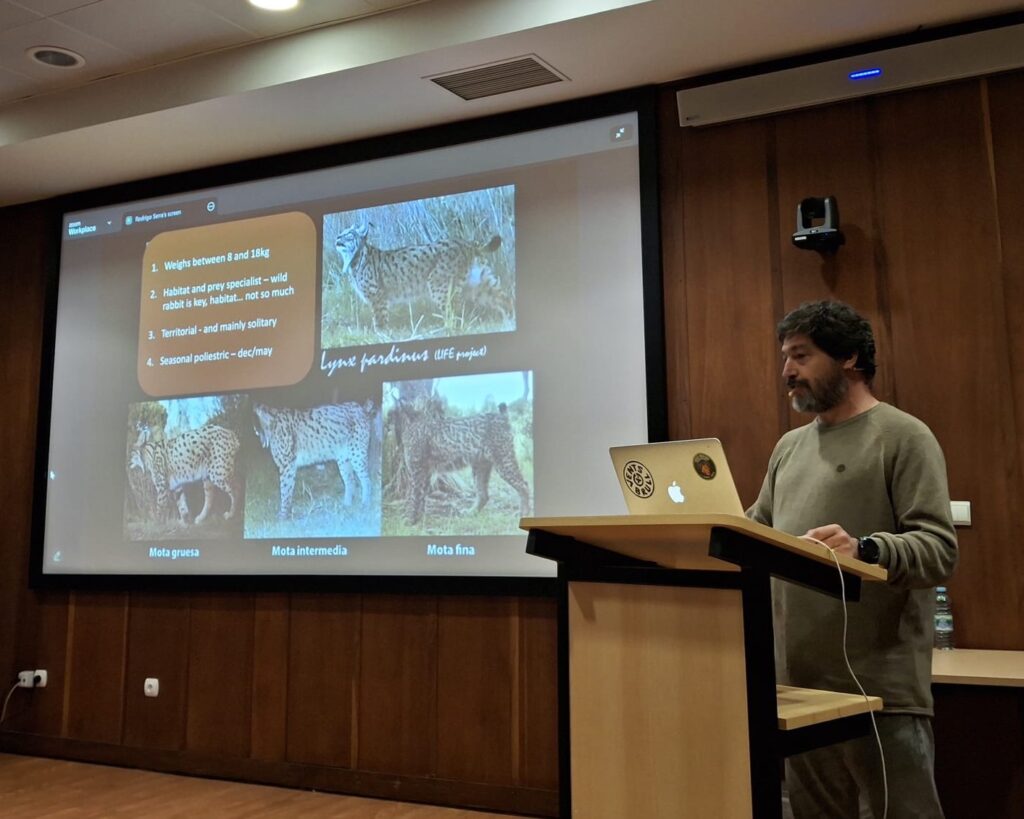
At the beginning of this century, the entire population of the Iberian lynx — an imposing feline that lives in Portugal and Spain — numbered fewer than one hundred individuals. In just over twenty years, thanks to the Iberian Lynx ex situ Conservation Programme, the population of what was once the most endangered cat in the world has surpassed 2,400 animals. In the latest session of GIMM’s Out of Our Box seminar, Rodrigo Serra, coordinator of the program, spoke to us about the journey so far, the difficulties that remain, and what still needs to be done to ensure the species does not disappear.
When he first got to work, almost everything had to be done. “Very little was known about the physiology, genetics, reproduction, clinical aspects, mating and behaviour,” he listed. The rescue strategy relied both on technology — using assisted reproduction techniques in the laboratory — and on more creative solutions, such as creating a system of tunnels and corridors to simulate a natural hunting environment. “We never keep a regular feeding schedule: it can happen in the morning, in the afternoon or at night, and they are never fed by human hands — we make them learn to hunt,” he explained.
During the presentation, Rodrigo showed us videos of a birth, of a fight between two animals — which quickly shift from “little angels to little demons” — and also of an epileptic seizure in one of the lynxes, a condition that affects a significant portion of this population.
Among the animals born in captivity, they achieved a survival rate of 75% — an absolute success! And a surprise, Rodrigo admits: “We were hoping reach 40 per cent.”
Even so, the work is far from finished. Poaching, as well as road accidents, continue to be threats. And the scarcity of food — the wild rabbit — remains a problem. This beautiful and demanding animal is very selective about what it eats, to the point of synchronising its life cycle with that of the rabbit. “The lynx can feed on other meat. But it only reproduces if it eats wild rabbit.”