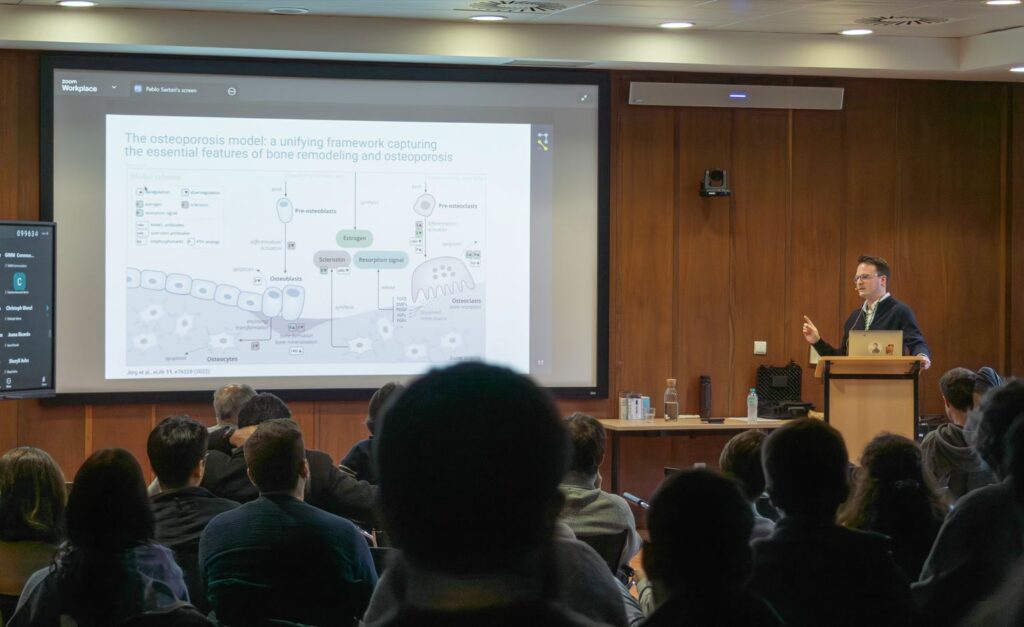
How can mathematical models help doctors choose better therapies – and even anticipate how a patient will respond before treatment begins? This question was at the center of a seminar by David Jörg, from the Renal Research Institute (RRI), New York, titled “Modeling human physiology to improve patient treatment – Examples from industry”, hosted at GIMM.
Jörg described how physiology-based mathematical models are being used in industry to translate biological knowledge into concrete clinical decisions, based on the experience at the RRI (a subsidiary of Fresenius Medical Care, the world’s largest dialysis provider, treating around 300,000 patients in 3,700 clinics worldwide). Rather than abstract theory, the work focuses on practical tools that simulate how the human body responds to disease and treatment, allowing researchers to test strategies virtually before they reach patients. “If we can simulate the biology,” he explained, “we can also simulate treatments that have never been tried before and explore their consequences safely and quickly.”
One of the examples Jörg presented focused on osteoporosis. By modeling bone turnover at the cellular level, the team can predict how different drug combinations affect long-term bone density. The approach begins with biology: understanding how cells interact, how hormones regulate bone formation, and how drugs intervene. That knowledge is then encoded mathematically and calibrated with clinical data. Once validated, the model can explore treatment strategies that have never been tested in real trials. “You can simulate clinical studies basically within a few seconds instead of carrying out a lot of cost and over many years and with many patients,” Jörg explained. The simulations reveal that simply changing the sequence of existing drugs can significantly alter outcomes – a cost-neutral improvement with potentially large clinical impact.
A second case study addressed anemia in patients with end-stage kidney disease. Here, the team built personalized models that adapt to individual patient data and support dosing decisions. The system generates recommendations, but clinical authority remains with physicians. As Jörg emphasized, “the treating physician has the ultimate responsibility and decides whether to follow that recommendation or not.” In a clinical study with 90 patients, the model-assisted approach increased the time patients stayed within healthy hemoglobin ranges while reducing drug use. The result, Jörg noted, is a rare alignment of benefits: “better treatment, less drug, means also less side effects, also means less money spent on drugs.”