
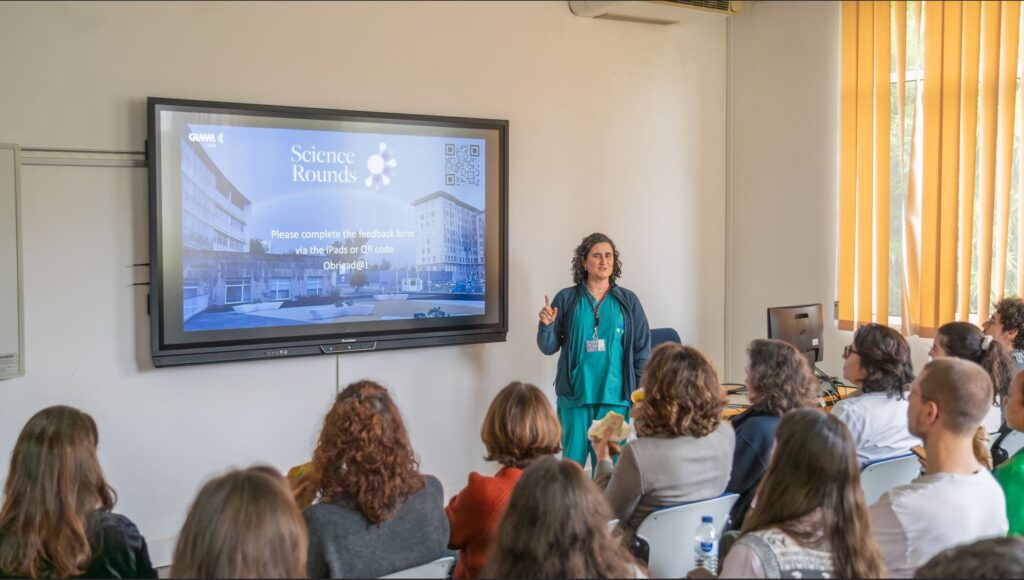
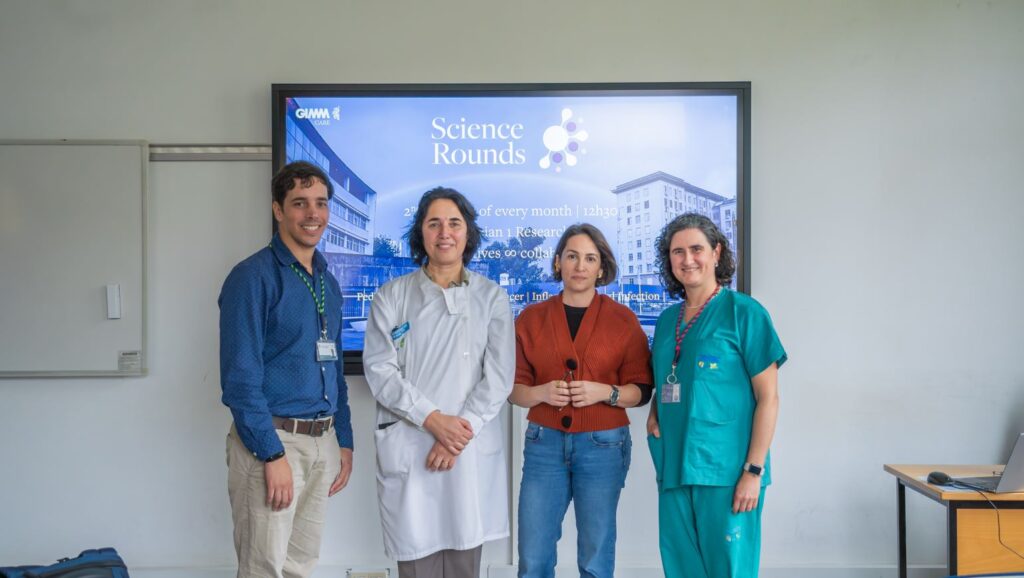
The last session of the Science Rounds, February 10, brought together clinicians and basic researchers at GIMM to explore Parkinson’s disease from complementary angles – from patient-centered genetic research to experimental neuromodulation strategies that could redefine future therapies.
Leonor Correia Guedes, from the Neurology Department at Unidade Local de Saúde Santa Maria, opened the session by highlighting the clinical and genetic complexity of Parkinson’s disease, presenting the talk Phenotype-driven translational research in genetic parkinsonism. Her team at the hospital focuses on genetic parkinsonism and other inherited movement disorders, through detailed clinical characterization and patient cohorts.
“We have to be sure in the first place what we are talking about,” the neurologist stressed, referring to the importance of strict diagnostic criteria. “If we don’t select correctly the patients we will never find the relevant things.”
Parkinson’s, she reminded the audience, is not only a motor disorder but a multi-system disease that requires imaging, biomarkers and validated clinical scales to capture its full spectrum. Since the early 2000s, her group has helped map the genetic landscape of Parkinson’s in Portugal, including key contributions to the identification of LRRK2 mutations – now recognized as one of the most frequent monogenic causes of the disease in Europe.
“Portugal has one of the highest frequencies of familial Parkinson’s associated with this mutation,” she noted, emphasizing how this positions local cohorts as crucial for international research consortia.
Beyond genetics, her team is pushing research into prodromal and preclinical stages of disease. By studying asymptomatic carriers of risk mutations, they aim to identify early biomarkers of neurodegeneration. “We could identify that these carriers already have neurodegeneration, although they still don’t manifest the disease,” she explained, pointing to neuromelanin MRI as a promising tool.
The group is also deeply involved in ethical questions around genetic counseling. Many patients, she said, feel underinformed about genetics but are open to testing if it could influence treatment. “Most of them would undergo genetic testing to have different medications,” she reported — a striking finding in a field where disease-modifying therapies are still emerging.
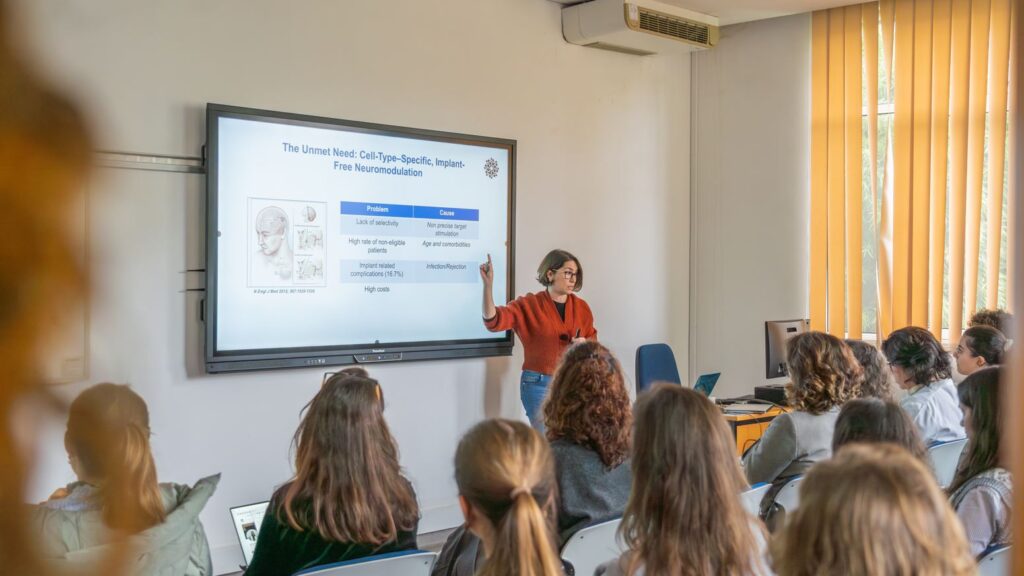
Complementing this clinical perspective, Luísa Lopes from GIMM presented a translational project that bridges neuroscience and neurosurgery, with the talk Creating a non-Invasive Neuron-specific Neuromodulation. At GIMM Luísa studies synaptic aging, but this collaboration grew from a simple message from a neurosurgeon seeking a way to test a bold idea: can we mimic deep brain stimulation without implants?
Deep brain stimulation is effective for advanced Parkinson’s, but invasive, and in some cases can cause adverse effects that may require treatment to be suspended. Lopes’ team explored an alternative based on luminopsins – engineered proteins that allow neurons to be activated through the use of a small chemical. “We thought it was a very nice idea,” the neuroscientist recalled.
Using viral gene delivery, the team activated a precise neuronal population in a mouse model of Parkinson’s. The result: measurable improvements in motor behavior. “We have a significant improvement,” Lopes said, describing increased speed and reduced immobility after treatment.
While still early-stage, the work suggests a future in which neuromodulation could be more selective and less invasive. “Since Parkinson’s disease involves a dysregulated circuitry, it’s a very good target for neuronal-specific strategies,” she concluded.
Together, the talks illustrated the power of cross-disciplinary exchange: from patient cohorts and genetic insight to experimental tools that may one day translate into new therapies. They also underscored a shared goal – understanding Parkinson’s not as a single disease, but as a dynamic system that demands collaboration across clinic and laboratory.
I was diagnosed with Parkinson’s disease four years ago. For over two years, I relied on Levodopa and several other medications, but unfortunately, the symptoms kept getting worse. The tremors became more noticeable, and my balance and mobility started to decline quickly. Last year, out of desperation and hope, I decided to try a herbal treatment program from NaturePath Herbal Clinic. Honestly, I was skeptical at first, but within a few months of starting the treatment, I began to notice real changes. My movements became smoother, the tremors subsided, and I felt steadier on my feet. Incredibly, I also regained much of my energy and confidence. It’s been a life-changing experience I feel more like myself again, better than I’ve felt in years.If you or a loved one is struggling with Parkinson’s disease, I truly recommend looking into their natural approach. You can visit their website at http://www.naturepathherbalclinic.com info@naturepathherbalclinic.com