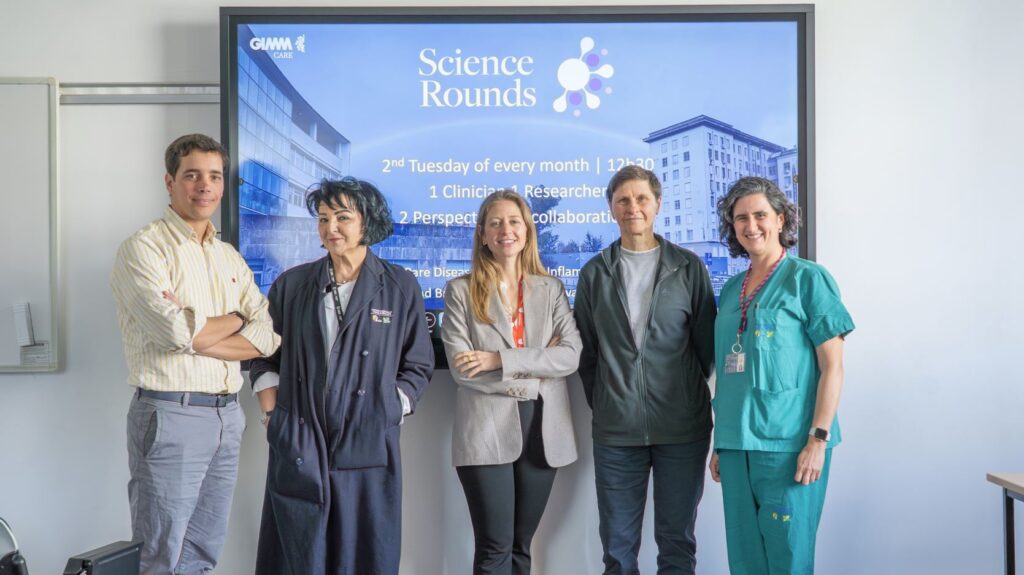
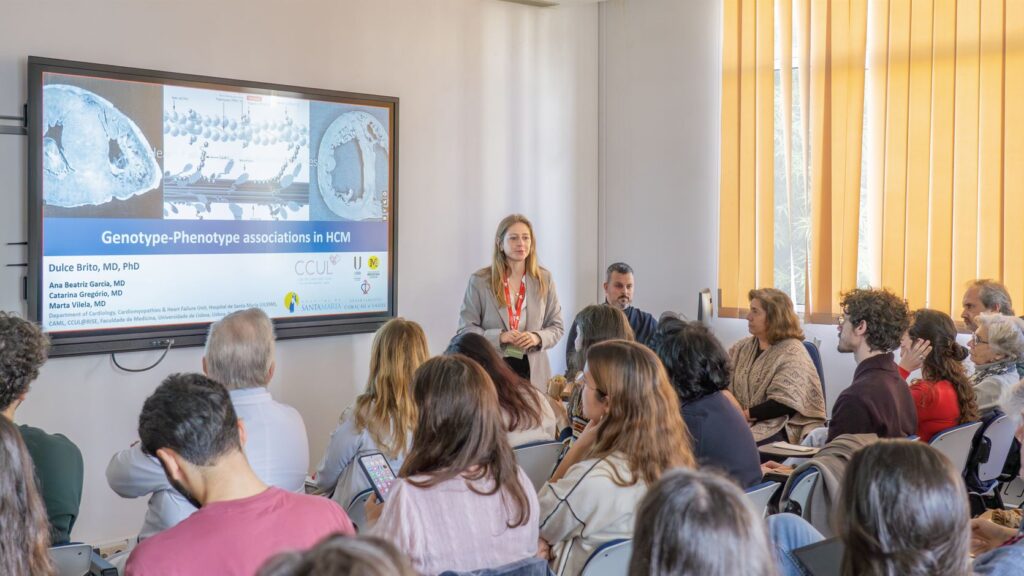
“In a fully packed room overlooking Hospital de Santa Maria, senior scientists, clinicians, nurses and PhD students gathered for the latest Science Rounds on March 10 to examine the biology of cardiomyopathies from complementary perspectives, spanning clinical genetics, molecular mechanisms and environmental influences on heart disease. The session featured talks by GIMM’s Group Leader Maria do Carmo Fonseca, whose research explores the genetic and RNA-based mechanisms underlying heart disease, and cardiologist Beatriz Garcia, from the Cardiology Department at Unidade Local de Saúde de Santa Maria.
Hypertrophic cardiomyopathy (HCM) is one of the most common inherited heart diseases, characterized by abnormal thickening of the heart’s left ventricle. The condition can lead to severe complications, including arrhythmias, heart failure, and sudden cardiac death, particularly in young people.
Drawing on more than four decades of clinical follow-up at Santa Maria Hospital, Beatriz Garcia discussed how genetic information can help explain the diversity of disease outcomes seen in patients. Since the early 1990s, researchers have known that mutations in genes encoding sarcomere proteins – the molecular machinery responsible for heart muscle contraction – can cause HCM. Yet in clinical practice, the picture remains complex. Only around 30–70% of patients carry a clearly identifiable pathogenic variant, and even among carriers the disease can present with strikingly different severity.
“Our patients show a very heterogeneous clinical course,” Beatriz Garcia explained. “Even today, predicting disease progression and the risk of sudden cardiac death remains extremely challenging.”
Focusing on three genes commonly associated with HCM – MYBPC3, MYH7, and α-tropomyosin genes, she presented studies from the Santa Maria cohort showing that MYBPC3 mutations, often considered relatively benign, still carry a significant risk of complications such as atrial fibrillation, heart failure, and arrhythmias. A meta-analysis led by her team, involving nearly 4,000patients, confirmed that although these mutations often present later in life, they can still lead to severe outcomes.
Research on MYH7 mutations revealed similarly complex patterns. While genetic variants in this gene are known to cause hypertrophic cardiomyopathy, the clinical outcomes varied widely among patients, making it difficult to link specific mutations to predictable disease trajectories.
The clinician also highlighted ongoing work on α-tropomyosin variants, which appear less frequently in the literature but may be under-recognized contributors to HCM. Studies of families in Portugal and Spain suggest that certain variants may have a founder effect in the region, raising important questions about their role in disease. Taken together, the findings illustrate a key challenge in cardiovascular genetics: while mutations can predispose individuals to disease, genetic information alone is often insufficient to predict how the disease will evolve.
Looking beyond genes
If genetics cannot fully explain the disease, what other factors are involved?
That question was addressed by Maria do Carmo Fonseca, who explored how genetic variation, cellular biology, and environmental influences intersect in cardiomyopathy.
A key focus of her research is RNA splicing, the process by which cells edit RNA transcripts before producing proteins. Mutations that disrupt splicing can impair the production of critical sarcomere proteins and contribute to cardiomyopathy.
Using induced pluripotent stem cells (iPSCs) derived from patients, Carmo Fonseca’s team can recreate heart cells in the lab and study how specific genetic variants affect cardiomyocyte function. These cells can be genetically edited using CRISPR to either introduce or correct mutations, allowing researchers to directly test their effects.

Even when the mutations are present in only one copy of a gene, the resulting cardiomyocytes already show subtle abnormalities, suggesting that disease processes begin long before clinical symptoms appear. But, as she emphasized, genetics is only part of the story.
Emerging evidence suggests that hypertrophic cardiomyopathy may exist on a continuum between monogenic and polygenic disease, where rare mutations interact with additional genetic variants and environmental influences.
One factor her team is investigating is chronic low-grade inflammation, a condition associated with aging, obesity, and certain lifestyle patterns. Inflammation can alter gene expression through epigenetic mechanisms and RNA modifications, potentially amplifying the effects of underlying genetic mutations.
“If a person carries a mutation and also experiences chronic inflammation,” the scientist explained, “these factors may combine to push cardiomyocytes toward a disease state.”
To test this idea, her group is exposing patient-derived heart cells to low levels of inflammatory cytokines – mimicking the subtle inflammation seen in everyday life rather than the acute inflammation typically studied in laboratory experiments.
Together, the two talks highlighted how hypertrophic cardiomyopathy sits at the intersection of genetics, cellular biology, and environmental influences. Despite decades of research, predicting who will develop severe disease, and why, remains a major scientific and clinical challenge. The combination of long-term clinical cohorts with cutting-edge molecular tools is allowing for researchers to form a gradually more complete picture.
As Beatriz Garcia noted: “We are not there yet, but we are learning more every year about how genetics, additional variants, and environmental factors shape this disease.”