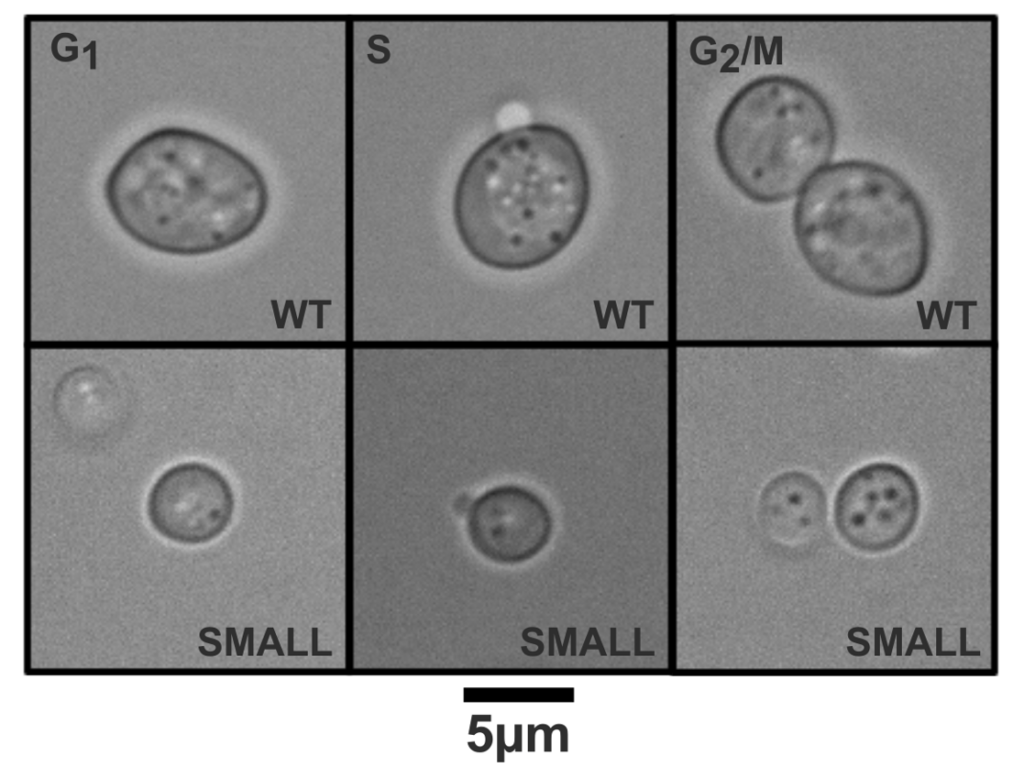
Why are cells the size they are? It may sound like a simple question, but cell size influences almost every aspect of cellular function – from growth and metabolism to ageing and disease. Nature has produced an extraordinary diversity of cell sizes and shapes. Nonetheless, when biologists try pushing particular cell types outside their normal size range, their growth is usually impaired.
How did evolution produce such variability in cell size if even small deviations from the norm are detrimental?
A new study, led by Marco Fumasoni, in collaboration with Andrea Giometto, from Cornell University, and supported by the Human Frontier Science Program, shows that evolution can find ways around that apparent biological constraint. Using experimental evolution in budding yeast, researchers selected cells to become progressively smaller over roughly 1,500 generations, while still maintaining relatively fast growth.
The work, published at PNAS, identifies mutations in conserved cellular pathways that allow strong reductions in cell size with only limited fitness costs.
“What was obvious from previous studies is that usually cells of a given type have a characteristic size, and that size is important for how the cell functions,” explains Marco Fumasoni. “If you make cells larger or smaller, they start to function less well.”
Why size matters
Cells possess robust mechanisms to maintain their size within a narrow range. Deviations can compromise their ability to divide, grow and regulate internal processes.
Previous attempts to shrink cells typically impaired growth, suggesting a strong trade-off between miniaturization and fitness. Fumasoni compares it to economics: “If you downsize the entire economy, you’re also downsizing the growth capability,” he explains. “But evolution managed to decouple these two things. The cells became very small, but they still grew quite fast.”
Instead of directly manipulating genes, the team relied on artificial selection – similar to how farmers selectively breed crops over generations.
“Exactly like farmers selecting cherry tomatoes,” Fumasoni says. “Every season you select the smallest ones and propagate them.”
Each day, researchers selected the smallest yeast cells from the population. But those cells also had to compete for nutrients and grow rapidly before the next selection round.
“In the morning we were selecting for cell size, and during the rest of the day they were competing for fitness,” he explains. “So evolution simultaneously selected for smaller cells, but also for cells capable of growing fast.” Over time, evolution identified genetic solutions that previous targeted engineering approaches had failed to uncover.
To uncover the mechanisms involved, the team sequenced entire yeast populations at multiple stages of the evolutionary experiment. Because frozen samples were preserved throughout the process, researchers could reconstruct the evolutionary trajectory of beneficial mutations over time.
“The advantage of experimental evolution is that you have an entire fossil record that you can revive to understand how biology has evolved,” he says.
By tracking which mutations increased in frequency across generations, the researchers identified genetic changes in conserved growth and cell-cycle pathways associated with smaller, fast-growing cells. Manipulating those genes confirmed causality and produced yeast cells spanning a six-fold range in size.
The findings suggest that gradual tuning of conserved growth and cell-cycle pathways may provide a general mechanism for the evolution of cell size.
Beyond yeast: potential links to ageing and cancer
Although the study focuses on fundamental biology, the findings may eventually have broader implications for ageing, cancer, and synthetic biology. These experiments were performed in budding yeast, a unicellular organism widely used in cell biology. But the core regulatory principles are conserved across eukaryotes. “Human cells control their size in a very similar way. The proteins involved can differ, but the regulatory principles seem to be the same”, Fumasoni notes.
The implications of this study could therefore extend to various applications. “There is a clear association between cell size, senescence and ageing,” Fumasoni explains. “As cells become larger and larger, they enter senescence more easily.” Cellular senescence – a state in which cells stop dividing – is one of the hallmarks of ageing and contributes to tissue dysfunction over time.
Tumours also frequently display highly irregular cell sizes and shapes, reflecting disruptions in normal size-control systems. This relationship remains largely under-explored, but researchers are increasingly investigating how cell size contributes to cancer progression, metastasis, and immune evasion.
Finally, these findings are highly relevant for synthetic biology. Fumasoni notes. “If you want to design cells with specific functions, you need to make them the right size.”
Being able to control the size of cells without affecting how fast they grow will therefore be a strong advantage in these applications.
For now, however, the study primarily offers something more fundamental: a glimpse into how evolution reshapes one of the most basic properties of life itself.