Can a butterfly teach its offspring what to like? Research presented by evolutionary biologist Antónia Monteiro suggests the answer may be yes.
During a seminar at GIMM, Antónia, Professor at the National University of Singapore, described how butterflies can learn new odours associated with mates and food plants – and how these acquired preferences can be passed on to the next generation. The findings challenge the long-held view that such behaviours are entirely hardwired and offer new insights into the mechanisms that drive adaptation and evolution.
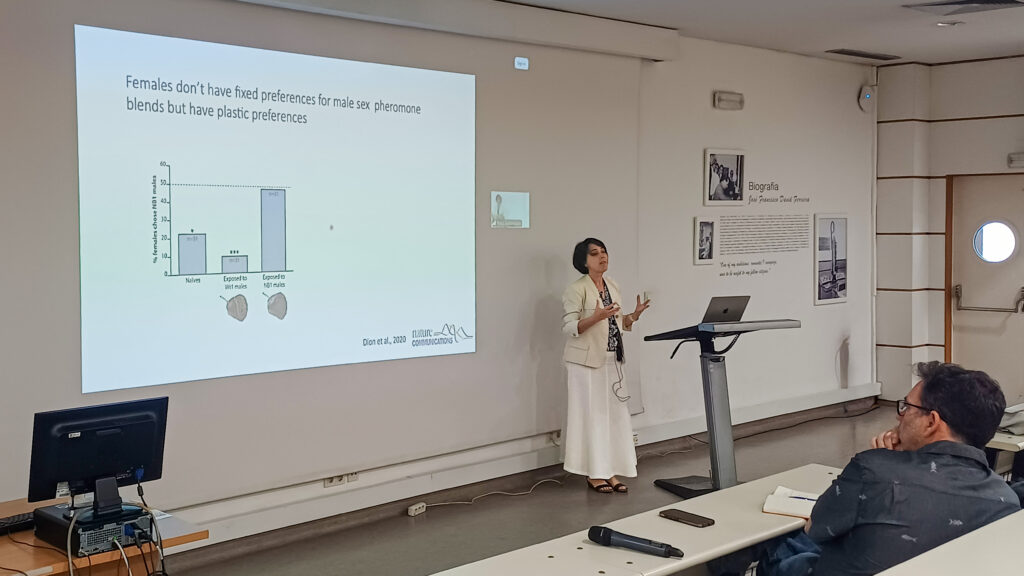
“We’ve shown that there is no fixed preference for a particular pheromone blend,” Monteiro said. “There is a plastic preference that can change with experience.”
Her team studies the African butterfly Bicyclus anynana, whose males produce species-specific blends of pheromones on their wings during courtship. By experimentally altering these chemical signals and exposing newly emerged females to the modified blends before they reached sexual maturity, the researchers found that females became more willing to mate with males carrying the novel scent.
Even more remarkably, their daughters inherited this altered behaviour despite never having encountered the new pheromone themselves.
“Pheromone odour preferences are inherited,” Monteiro explained. “We believe this type of learning may facilitate changes in mate preferences and contribute to assortative mating and, potentially, speciation.”
The group also investigated what happens inside the insects’ nervous system during this process. Analyses of the brain and antennae revealed extensive molecular changes following odour exposure, including widespread alternative RNA splicing and modifications in DNA methylation patterns of genes involved in olfaction.
Rather than changing which genes are switched on or off, the butterflies appear to change how many of those genes are processed, generating different protein variants that may reshape neural circuits involved in smell and memory.
The same phenomenon extends beyond mate choice. In a second series of experiments, Monteiro’s team exposed caterpillars to novel plant odours by adding specific aromatic compounds to their food. Larvae that initially avoided these smells gradually developed a preference for them as they fed, and this newly acquired preference was also transmitted to their offspring.
The researchers then uncovered an unexpected clue about how this information might be inherited. By transferring haemolymph – the insect equivalent of blood – from odour-exposed caterpillars into unexposed individuals, they were able to reproduce the behavioural change in both the recipients and their descendants.
“It does travel in the blood,” Monteiro said. “We still don’t know what the factor of inheritance is, but we know it is there.”
Current work aims to identify this mysterious signal. The team is investigating whether small RNA molecules, extracellular vesicles or even the odour molecules themselves could carry information from the nervous system to the reproductive cells, allowing learned experiences to influence the next generation.
Beyond revealing an unexpected form of biological inheritance, the findings may help explain how butterflies adapt to new environments. Learning new host-plant odours could allow populations to exploit previously unsuitable plants, while inherited changes in mate preference could reinforce reproductive isolation between diverging populations. “Odour learning,” Monteiro concluded, “might facilitate host-plant switching, changes in mate preferences and ultimately contribute to the process of speciation.”