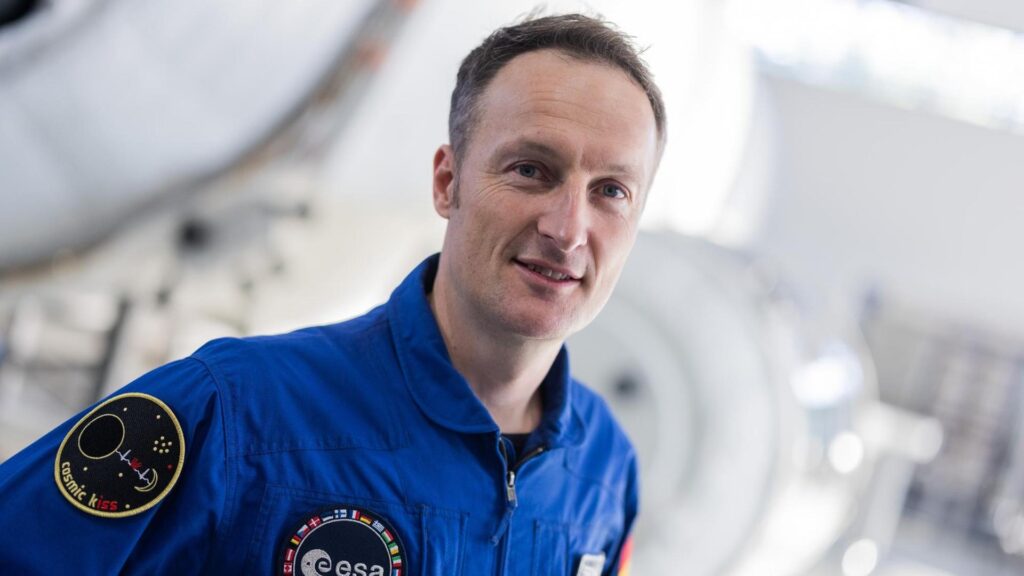
ESA astronaut Matthias Maurer, who spent 177 days on the International Space Station, will speak to the public on 22 October at the University of Lisbon Faculty of Medicine. The talk is part of the Science and Space Symposium and is free to attend.
Muscles weaken, bones lose mass and the body forgets gravity. Matthias Maurer went through all of this during 177 days aboard the International Space Station (ISS) and, when he returned, admitted that readjusting to Earth was harder than learning to live in weightlessness. On 22 October, the European Space Agency (ESA) astronaut comes to Lisbon to talk about the experience in a conversation open to the public, as part of the Science and Space Symposium: Biomedical Research Beyond Earth, held on 21 and 22 October at the Faculty of Medicine of the University of Lisbon.
During the Cosmic Kiss mission, between November 2021 and May 2022, Maurer took part in dozens of scientific experiments and carried out a spacewalk. Some of the research was done on his own body. As he acknowledged at the time, astronauts are “kind of guinea pigs”, studied 400 km above the Earth. On the ISS, he measured the elasticity and stiffness of his own muscles, photographed his own retina with a clinical lens and tested his hearing, exposed to the station’s background noise. Muscles, eyes and ears deteriorate with age, and even more so in space; an astronaut’s body therefore offers clues to fighting human ageing on Earth.
The conversation, moderated by Sara Sá, head of science communication at the Gulbenkian Institute for Molecular Medicine (GIMM), starts at 3 pm and is free to attend, with no registration required.
Earlier the same day, at 11:30 am, in a session that is part of the scientific programme and requires registration, Maurer will share the stage with Portuguese researcher Diogo Paupério Abreu, from INESC TEC, who spent 100 days in confinement for SOLIS100, a study of the effects of isolation on long-duration space missions. One has known isolation in orbit; the other, on Earth.
The day ends at 3:50 pm with a round table featuring GIMM CARE, the Faculty of Medicine of the University of Lisbon (FMUL), the Portuguese Space Agency and AED Cluster Portugal, which closes the Science and Space Symposium: Biomedical Research Beyond Earth.
Over the two days, researchers and clinicians will discuss ageing, the microbiome, radiation and the cardiovascular system, problems that hospitals and orbit have in common. Maurer has already contributed to two of them: he installed radiation sensors at ten points on the ISS and tested new antimicrobial surfaces in space conditions.
The results of these experiments, and of those by other ESA astronauts, are in Lisbon, at ESA’s Exploration Biobank, housed at GIMM. The symposium is organised by GIMM, FMUL and the Portuguese Space Agency.