
At the Triple-Negative Breast Cancer Workshop | What Is New | What Comes Next (October 23), we learned about the clinical challenges posed by triple negative breast cancer (TNBC) and the current efforts from researchers, doctors and pharmaceutical industries to address the unmet clinical needs for better diagnosis and management of the disease.
When a breast cancer lacks expression of the estrogen and progesterone hormone receptors and of the receptor HER2, it is classified as TNBC. For most breast cancer types, therapeutic agents target those receptors and deliver the therapy directly to the tumor cells while sparing neighboring tissues which do not express breast-specific genes – the heart or lungs, for example. In the absence of those ‘beacon-like’ receptors, TNBC is difficult to treat.
Despite the exciting developments in TNBC research and the new experimental therapies that have resulted from it – that we came to know off at the workshop organized by Marco Calvinho, from Miguel Castanho’s Lab – some tumor cells escape treatment and metastasize to other parts of the body, among them, quite frequently, the brain.
Therapeutic targeting of the brain is very challenging because the blood vessels that provide useful nutrients to the brain are enveloped by a layer of specialized cells that filter out potentially harmful chemical substances. This filtering system is commonly known as the blood-brain barrier (BBB). And so, anti-cancer drugs, which are in essence cell-killing agents, are normally kept outside the brain by the BBB.
But there might be a way to overcome it, and Miguel Castanho’s team has shown. On a previous work, published two years ago, the team developed a peptide called anti-cancer peptide vCPP2319 that efficiently kills cultured TBNC cells. By tethering vCPP2319 to the brain peptide shuttle PepH3 they created a dual active anti-cancer peptide (vCPP2319-PepH3) with the potential to pass through the BBB and kill metastatic TNBC cells in the brain.
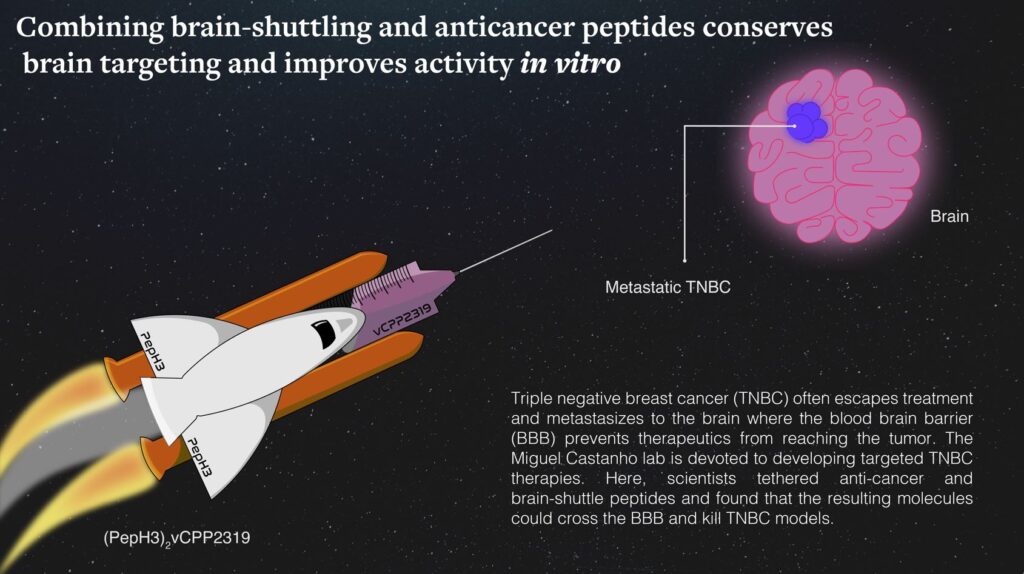
In a new study, “Combining brain-penetrating and anticancer peptides into bivalent-branched peptides conserves brain targeting and improves activity in vitro”, led by PhD student Patrícia Fraga, the team further improved this strategy. In a collaboration with Barcelona Biomedical Research Park (PRBB), the researchers combined either two copies of the anti-cancer with one copy of the shuttle peptide ((vCPP2319)2PepH3) or vice versa, two copies of the shuttle with one of the anti-cancer peptide ((PepH3)2vCPP2319). They tested how well those bivalent-branched peptides can travel through laboratory models of the BBB, their efficacy in killing tumor cells and safety for use on human tissues.
Both bivalent-branched peptides could pass through the BBB as efficiently as vCPP2319-PepH3 and were chemically stable in human serum. In addition, the peptides could enter TNBC cells in culture or in organ-like spheroid assemblies, kill them with higher efficiency than their monovalent predecessor, while presenting moderate toxicity to non-TNBC cells in culture. Together these results suggest that the two bivalent peptides could be formulated into effective and safe therapeutics. Comparing the two bivalent peptides with each other, (PepH3)2 vCPP2319 was more active than (vCPP2319)2PepH3).
“One of the greatest challenges in treating brain metastases is not only developing drugs capable of eliminating cancer cells but also ensuring that these drugs can reach the brain. With this study, we demonstrate that by combining brain-penetrating and anticancer peptides into a single, branched molecular structure, we can improve anticancer activity while preserving the ability to cross an experimental model of the blood-brain barrier. Although we are still at an early stage of development, these findings bring us one step closer to designing more effective, brain-targeted therapies for patients with triple-negative breast cancer” said Marco Calvinho Cavaco who co-designed and supervised the study.
In summary, the bivalent-branched peptides in this new study are stable, BBB permeable, effective against TNBC and safe to use in pre-clinical models. Based on these criteria, the team recommends the best-performing peptide, (PepH3)2 vCPP2319, for further testing – first in animal models and ultimately as an investigational new drug. Although a lot of work remains until (PepH3)2 vCPP2319 could be used in the clinic, the authors are optimistic about the future of metastatic TNBC treatments.