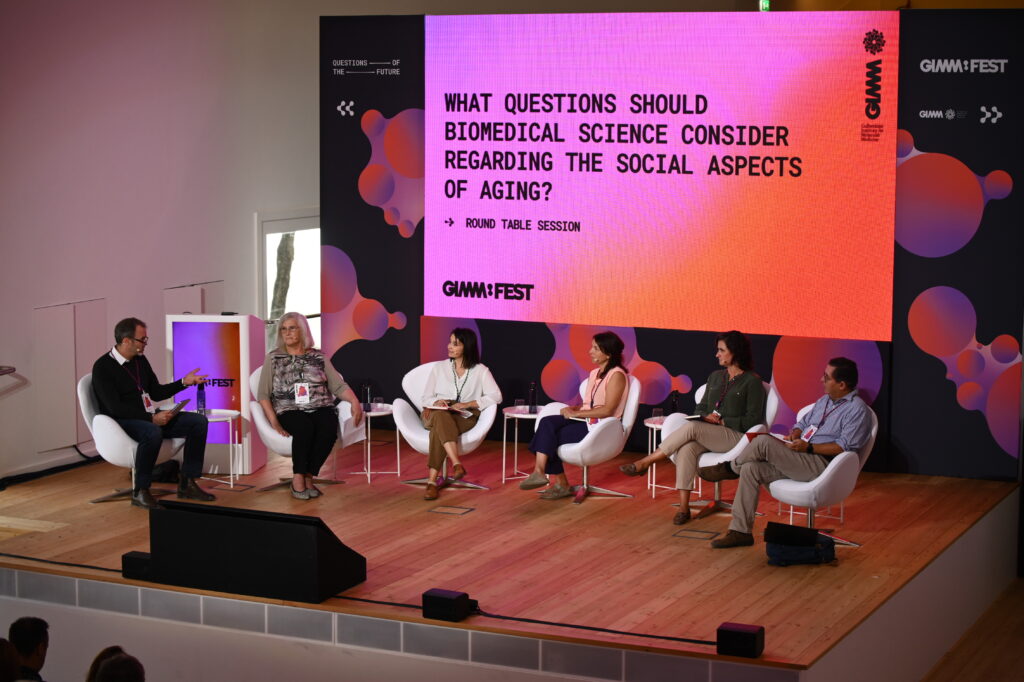
How biomedical science intersects with the social aspects of aging was the central theme of the morning roundtable on the second day of the GIMM Festival.
In the last two decades, life expectancy in Portugal has increased by five years. Today, 25% of the Portuguese population is aged 65 or older—more than two million people, one in every four. By 2050, they will represent 33% of the population. Good news, but with economic consequences, especially for the National Health Service.
For Luísa Louro, data analyst at Pordata, her current research focus is on people who are now 50 or younger. The main goal is to project and quantify the family support they will need in the future. Families today are smaller and more diverse than in their parents’ and grandparents’ generations, when larger family networks provided broader support. Her research aims to identify what kinds of savings people should be making now, with retirement and later stages of life in mind.
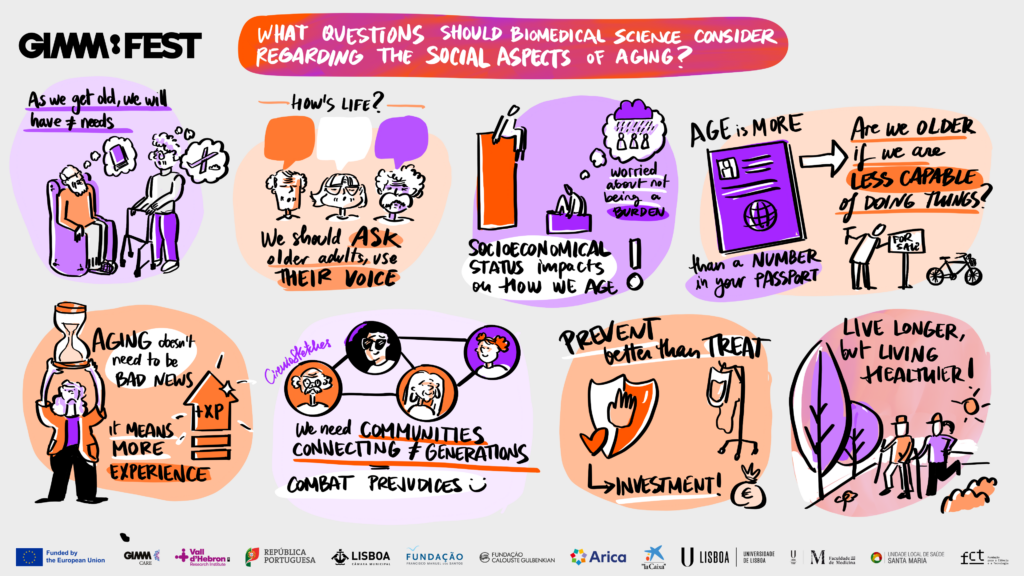
These ideas echo the perspective of Pedro Pita Barros, economist and full professor at Nova University Lisbon, who explains how social systems must adapt to people’s needs and preferences. “The social system will not be able to give equal support to everyone, and that differentiation is usually seen as a problem. Different people, with different needs, should be treated differently by the systems,” he stressed.
In fact, the issue does not come from aging itself, nor from its negative connotation. The real question is: what is the benefit of a longer life, and what value is assigned to it within the economic structure?
The debate also included Daniela Craveiro, from ISEG – Lisbon School of Economics and Management; Sara Mas Assens, from Vall d’Hebron Institut de Recerca in Barcelona; and Cláudia Faria, researcher at GIMM, Lisbon School of Medicine, and physician at Santa Maria Local Health Unit. All agreed that seniors must be involved in the conversation about active aging, sharing their needs directly. When people from more privileged socioeconomic backgrounds are asked what they need to feel well, the answer tends to focus on personal fulfillment, while among less privileged groups the priority is to provide financial and emotional support to children and grandchildren.
With the concept of old age shifting, participants unanimously highlighted the need to raise the age threshold that defines senior status in Portugal (set at 65 since 1989) in order to better target social support. More than one million Portuguese are 75 or older, and it is within these age groups that diseases become most critical.
From a clinical perspective, Cláudia Faria argued that the definition of aging itself should also change, aging is not a disease, but rather the trigger of diseases. “We need to put money into prevention. In 10 to 15 years, investment in prevention will need to outweigh investment in treatment,” she emphasized.
Aging, she added, is also synonymous with gaining experience, which should be harnessed to design a career plan for retirement years. “[Older people] can teach the younger generations, passing on knowledge,” suggested the physician. “You’re never out of the labor market—you simply take on a new role,” concluded Pedro Pita Barros.