It is fascinating to see how, when faced with the same question, different scientists give different answers — even though each of them brings the necessary scientific evidence to support their conclusions. Many are complementary; others run in parallel.
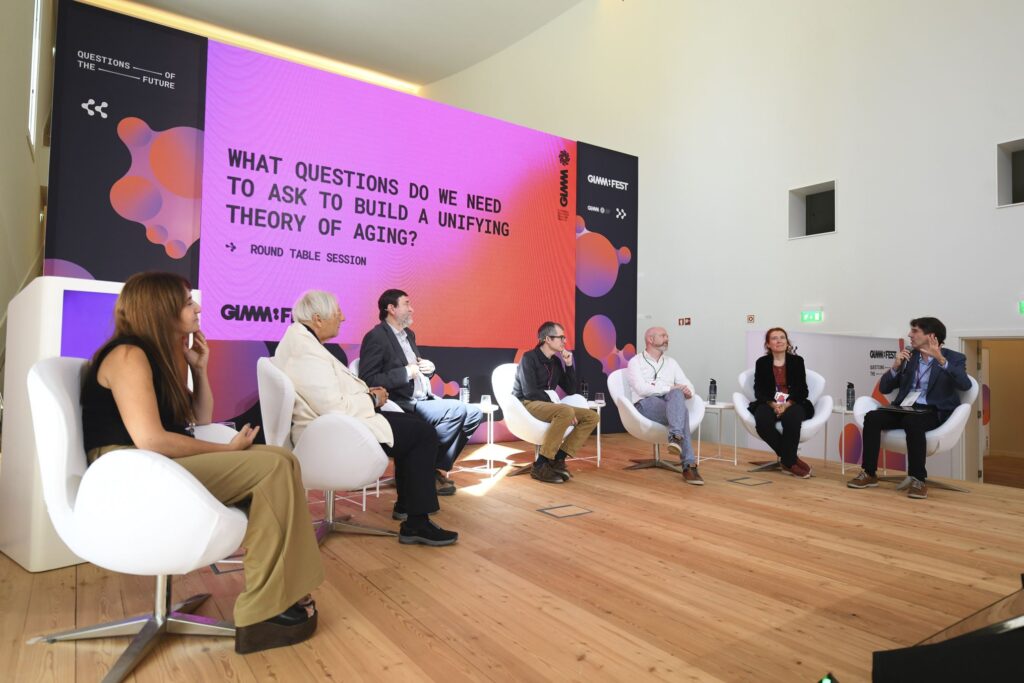
On the GIMM Fest stage, one dilemma unites them all: What questions must we ask to build an integrated theory of aging?
The question is raised by João Pedro de Magalhães, who moderated the first roundtable of the festival. Vera Gorbunova, Björn Schumacher, Peter Adams, Andrei Seluanov, Claudio Franceschi, and Elsa Logarinho shared convictions, certainties, and new perspectives.
For Vera Gorbunova, the answer is clear: epigenetics plays a decisive role — a view shared by Andrei Seluanov and Elsa Logarinho. Björn Schumacher, however, draws attention to a crucial distinction: “In the discussion about unifying the theory of aging, it is important to distinguish the ‘why we age’ — which evolutionary biology can answer — from the ‘how we age’.” Through inflammation? Proteostasis? Mitochondrial metabolism? “DNA is the first problem evolution must repair; it is the mechanism that is always present,” he summarizes.
Peter Adams has no doubts in pointing to homeostasis as the first system to “break down.”
Father of the concept of inflammaging, Claudio Franceschi insists: “The only unifying idea of aging is inflammation,” since many forms of damage in the body translate into it. Yet, he notes, each cell — just like each organism and even each population — ages differently, despite simple mechanisms in common.
“When does aging begin?” asks Elsa Logarinho, pointing to the role of heterogeneity: each cell has different “keys.”
As the audience waits for answers, new questions arise — fuel for scientific curiosity: Why are babies born young if they come from two already aging cells? Why does a mouse age twenty times faster than a human?
While humans invest in their maintenance, leading to genetically more robust cells, rodents reproduce as quickly as possible before falling prey to predators, bypassing some of the maintenance mechanisms.
“In vitro, cells have mechanisms to repair themselves and, even while accumulating mutations, can live forever,” explains Björn Schumacher. “In theory, life can be perpetuated indefinitely, and immortality could become a possibility.” After all, who has never dreamed of being immortal?
For the first time, the hypothalamus — the region of the brain integrating the nervous and endocrine systems — enters the debate as a key factor influencing systemic mechanisms of aging. When homeostasis fails, inflammaging emerges.
Turning to the immune system, Franceschi travels 500 million years back, to the appearance of T cells and the thymus, milestones in human complexity — a price we continue to pay. “The current immune system increases vulnerability to aging, while the older, simpler one is the root of inflammation,” he explains.
“Accelerated aging of the brain or the immune system increases the risk of age-related diseases,” warns Schumacher. But for Vera Gorbunova, these two systems “are not essential for life.”
Aging also brings two immune-related phenomena: a rise in autoimmune diseases and mass production of antibodies. At this stage, the body begins to react against its own molecules, especially when they change location — moving, for example, from the mitochondria to the cytoplasm, and then into the blood. A vicious cycle in which stress also plays a role.
“Stress kills us,” Vera asserts. Yet, she adds, some stress is essential for balance — whether from calorie restriction or physical exercise.