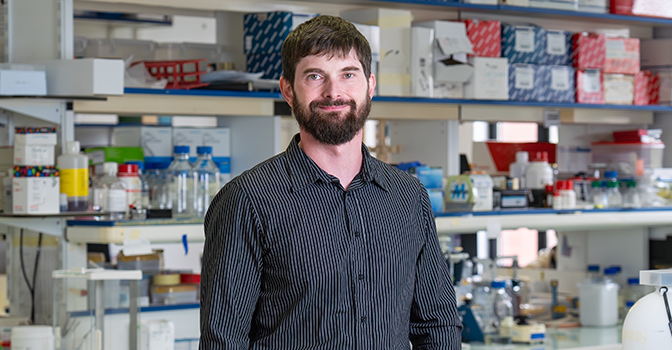
The laboratory will be led by researcher Pavel Hanč, who joins GIMM after nearly a decade at Harvard Medical School. In Portugal, he will study how neurons responsible for pain and itch influence immune responses, an emerging field with potential for new therapeutic approaches in inflammation and cancer.
The Gulbenkian Institute for Molecular Medicine (GIMM) announces the arrival of Pavel Hanč as a new Group Leader. The researcher will establish the Peripheral Neuroimmunology Lab, dedicated to studying how the nervous system influences the immune system.
Hanč’s work focuses on nociceptors, sensory neurons responsible for the sensation of pain and itch. While pain has long been recognized as a classic sign of inflammation, recent discoveries show that communication between the nervous and immune systems is bidirectional: beyond responding to inflammation, nociceptors can also actively modulate immune function in contexts such as allergies, infections, cancer, and tissue repair.
At GIMM, the new laboratory will study the mechanisms that regulate this communication. The research will focus on three main areas: understanding how nociceptors interact with dendritic cells, which are essential for initiating immune responses; studying the interaction between nociceptors and monocytes (a type of white blood cell involved in the body’s defense and inflammation) and their potential impact on tumor growth; and identifying new forms of communication between neurons and immune cells. The goal is to generate knowledge that may contribute to the development of new therapeutic approaches for inflammatory diseases and cancer.
Before joining GIMM, Pavel Hanč was at Harvard Medical School in the United States, where he worked for nearly a decade. He obtained his PhD from the Francis Crick Institute in London, United Kingdom. According to the researcher, the decision to establish his lab in Portugal was driven by the combination of scientific diversity, infrastructure, and the institute’s collaborative culture.
“The diversity of research carried out at GIMM, together with its state-of-the-art scientific infrastructure, makes this institute the perfect place to develop a research program that bridges immunology, neuroscience, genomics, and molecular biology”, says Pavel Hanč.
For Maria Manuel Mota, CEO of GIMM, Hanč’s arrival reinforces the institute’s strategy of attracting outstanding international talent. “Pavel’s research lies in an emerging field that is transforming how we understand tissue biology and how the body responds to different challenges. It is high-level science with the potential to open new areas of discovery and generate long-term impact, transforming our understanding of health and disease. We are very excited to welcome him to GIMM and confident that his work will further strengthen our scientific community and its international networks”.
Returning to Europe marks a new chapter for the researcher. “I am very grateful for the opportunity to establish my laboratory at a leading institution and, at the same time, contribute to the scientific community in Portugal, particularly through the opportunity to help train the next generation of biomedical scientists and further explore this still largely untapped therapeutic space”, Hanč adds.
By expanding knowledge about the communication between the nervous and immune systems, GIMM’s new Peripheral Neuroimmunology Lab aims to contribute to the development of a new generation of treatments that may benefit patients worldwide. The laboratory will begin its activities this year.