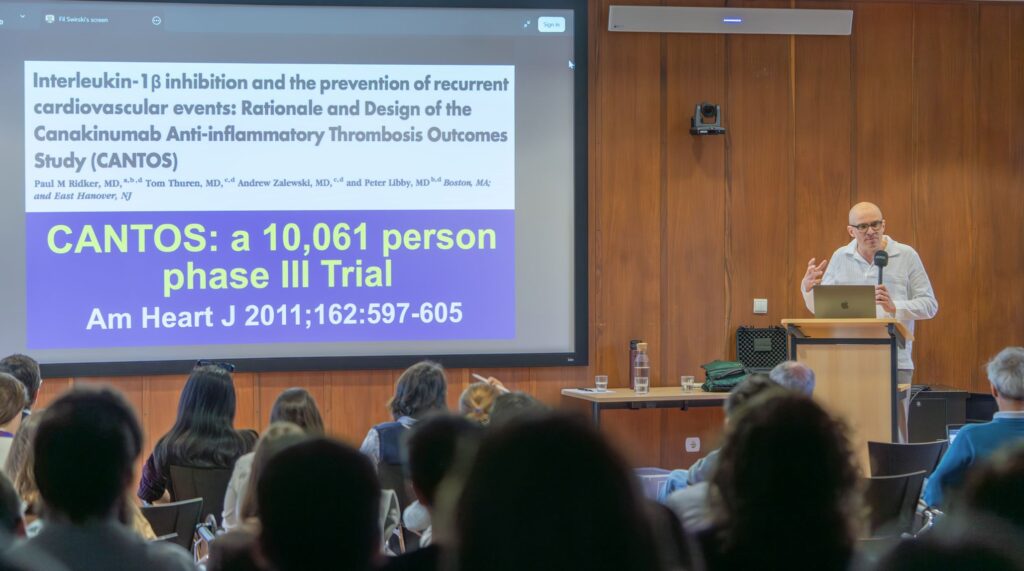
A heart attack is a traumatic event that triggers a critical process of repair, scarring and adaptation. But recovery does not involve the heart alone – the brain also plays an active role, as shown by Filip Swirski, director of the Cardiovascular Research Institute at Icahn School of Medicine at Mount Sinai, during a seminar at GIMM.
Using whole-brain imaging in mice after myocardial infarction, Swirski’s team showed that injury to the heart leads to highly specific changes in brain activity, suggesting that cardiac recovery may depend on close communication between the brain and the immune system – a connection that remains only partly understood.
One of the brain regions where the impact of a heart attack was most evident was the hypothalamus, a key centre for hormonal regulation and stress responses. Three days after myocardial infarction, this region showed a marked reduction in activity. According to Swirski, this may help explain how the body temporarily adjusts hormonal pathways to allow immune cells to reach damaged heart tissue and initiate repair. “The brain is not simply reacting to the heart attack; it may be actively influencing the inflammatory response that follows,” he explained.
To observe these changes, the researchers used advanced techniques capable of mapping active neurons across the entire brain. They also found that different forms of stress, such as acute psychological stress or inflammation resembling viral infection, activate distinct brain circuits, suggesting that the brain recognises and organises specific responses to different physiological threats.
During the seminar, Swirski also discussed the unexpected role of the immune cell’s macrophages on the control of systemic cholesterol, protecting against plaque build-up in the arteries, known as atherosclerosis. An hypothesis that emerged from the analysis of genetic data and human samples.
Macrophages, present in adipose tissue, can become particularly efficient at capturing and processing cholesterol, helping to remove it from circulation. “The macrophage opens for business,” Swirski said, using the expression to describe how these cells shift into what becomes, in effect, a metabolic clean-up mode. One idea runs through all this work: in many diseases, including the very common myocardial infarction, it is only possible to fully understand the condition by looking beyond the affected organ. In this case, heart, brain and immune system are in constant dialogue, and that communication may hold new answers for treating cardiovascular disease.