A leading immunologist at University of Cambridge, Adrian Liston – who brought us the talk “Harnessing regulatory T cells in the tissues” – studies the mechanisms that prevent the immune system from attacking the body, and how failures in these pathways contribute to autoimmune disease and inflammation. Recently awarded a Wellcome Discovery Award, his current research investigates how immune cells enter the brain and promote repair in multiple sclerosis.
But before diving into the science, he began with something less often highlighted at conferences: failure.
“What happens so often at conferences is that people show the best stuff that worked over the last ten years, and it makes it look as if everything in the lab works,” he told the audience. “We have tons and tons of failures. Most of what we do fails. Because that’s how science is for most people.”
At the centre of the seminar were regulatory T cells, or Tregs, specialised immune cells responsible for preventing excessive immune reactions.
“Most immune cells are activating parts of the immune system,” Liston explained. “Regulatory T cells are programmed in the opposite direction. They are the most important brakes on the immune system.”
These cells are controlled by a transcription factor called FOXP3, which transforms them from inflammatory cells into anti-inflammatory ones. Without them, severe autoimmune disease rapidly develops. But too many Tregs can also become a problem, suppressing anti-cancer or anti-infection responses.
“Like anything in the immune system,” he said, “it’s about having the right amount at the right time, activated in the right place.”
Immune cells that don’t stay put
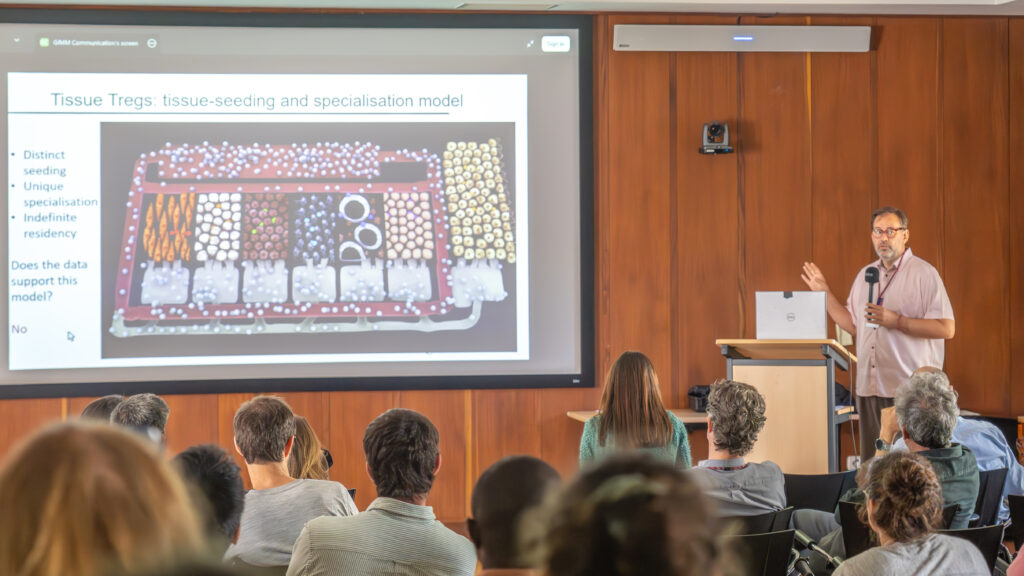
For years, scientists believed tissue Tregs permanently settled inside organs, becoming highly specialised depending on whether they were located in the liver, skin or muscle.
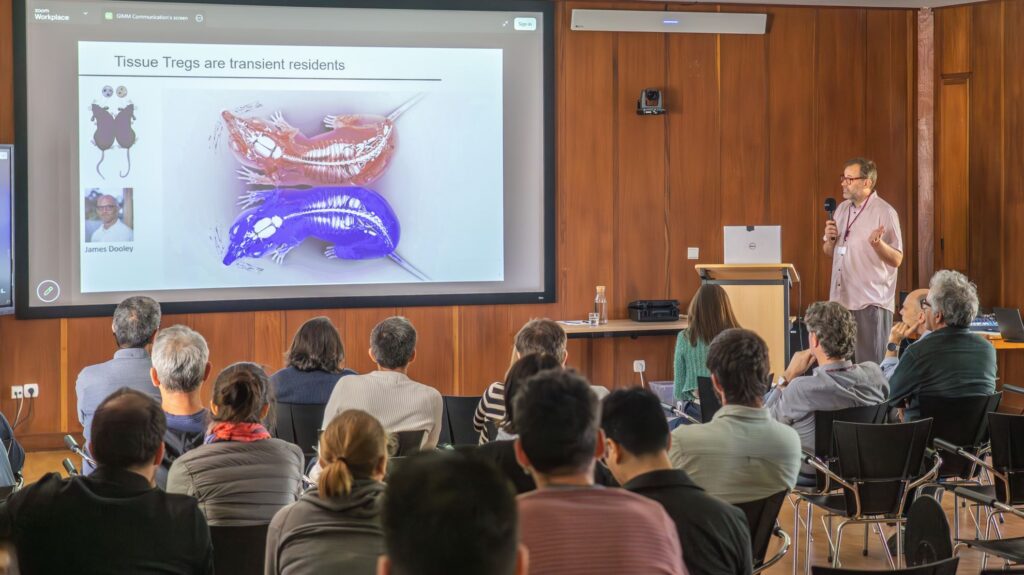
Liston’s work suggests otherwise. Using experiments that tracked immune cells across multiple tissues in mice, his team found that Tregs are remarkably mobile. Rather than permanently residing inside organs, they continuously circulate through the body, temporarily entering tissues before leaving again. “The answer is: they move.”
On average, these cells remain in a tissue for about three weeks before either dying or migrating elsewhere. The finding challenges the traditional view of fixed tissue-specialised immune populations. Instead, Liston proposed what he called a “pan-tissue” model, where Tregs behave more like travelling regulators than permanent residents. “They’re more percolating across the body,” he explained.
Understanding how Tregs enter and leave tissues became the next challenge. Initially, the team followed the standard scientific approach: selecting candidate genes one by one and testing them individually. The results were underwhelming. “My hypotheses were not great,” Liston joked. “I kept getting the wrong genes.”
To overcome this, the researchers developed a large-scale CRISPR screening system using fluorescent “flow codes”, allowing hundreds of genetic perturbations to be tested simultaneously in living mice. The approach revealed specific molecular signatures controlling how immune cells migrate into different organs.
Some of these pathways are already targeted by existing drugs, opening potential new strategies for manipulating immune responses therapeutically.