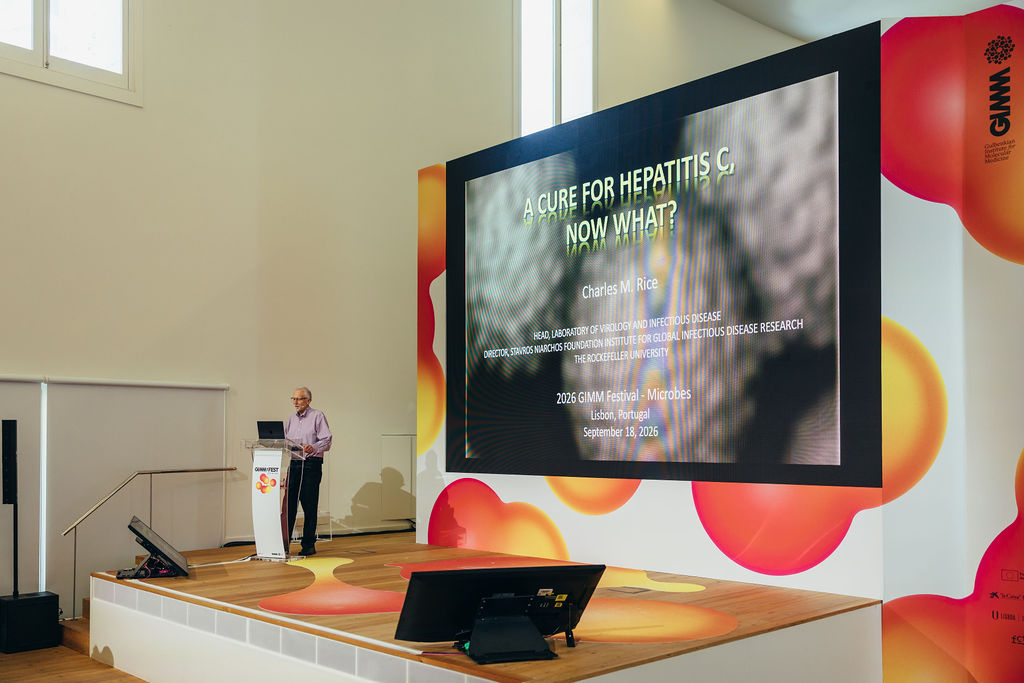
The way to a scientific discovery is very rarely a straight line. On the keynote at GIMM Fest, Nobel Prize-winning virologist Charles Rice took the audience through the long, often frustrating journey, that led him to identify the hepatitis C virus (HCV), creating the conditions for the development of highly effective treatments that completely changed the course of the disease. A story of technical obstacles, scientific detours and a lot of persistence.
Charlie – as he likes to be addressed – began with his own path into virology, which started almost by chance when, as a PhD student at Caltech in the 1970s, he joined a laboratory working on RNA viruses. The emerging tools of molecular biology were opening new possibilities for studying viruses at the genetic level, and this shaped his early research. His work on yellow fever and other flaviviruses would eventually provide the knowledge and techniques that helped him tackle a much more difficult problem: hepatitis C.
At the time, hepatitis C was still an unidentified cause of what was known as non-A, non-B hepatitis. The virus was eventually identified in 1989, but studying it proved extraordinarily difficult. HCV could not readily be grown in cell culture, there was no suitable small-animal model, and researchers had to rely heavily on chimpanzees. On his talk, Charlie described how his laboratory repeatedly tried, and failed, to establish systems that would allow them to study the virus experimentally.
One breakthrough came in 1997, when his team succeeded in producing infectious HCV RNA capable of causing infection in chimpanzees. Another major advance followed in 2005, when researchers finally developed a cell-culture system capable of supporting the complete HCV replication cycle. These experimental systems transformed the field, making it possible to investigate the virus in detail and, crucially, to test potential antiviral drugs.
Rice then traced the development of treatments targeting key viral proteins involved in replication and assembly. The arrival of direct-acting antivirals transformed hepatitis C treatment. Today, combinations of these drugs can cure infection in two to three months, with cure rates approaching 100% in most patients. Their effectiveness is particularly remarkable given the enormous genetic diversity of HCV: a chronically infected person can generate an estimated trillion viral variants in a single day.
But the scientific victory has not yet translated into the elimination of hepatitis C. Rice stressed that identifying infected people, ensuring access to diagnosis and treatment, affordability and reaching different patient populations remain major challenges. He pointed to Egypt as an example of what can be achieved when affordable treatment and large-scale public-health action come together: the country has dramatically reduced its hepatitis C burden after having one of the world’s highest rates of infection.
A vaccine, however, is still missing. And despite the effectiveness of treatment, people who have already developed liver damage remain at risk of hepatocellular carcinoma. Rice therefore described his laboratory’s work to develop a small-animal model that could help researchers understand the mechanisms linking chronic HCV infection, liver inflammation, fibrosis and cancer. A model based on a hepatitis C-like virus from Norway rats has shown particularly promising results: infected mice can develop chronic infection, progressive liver fibrosis and, at high frequency, liver cancer.
Rice ended by stepping back from hepatitis C to reflect on how scientific progress happens. The story of HCV, he argued, was the product of a worldwide effort involving basic researchers, clinicians, patients, biotechnology and pharmaceutical companies. Many of the breakthroughs could not have been predicted in advance. His final message was broader than hepatitis C: infectious diseases are not going away, and science needs to be prepared rather than merely reactive. Given the complexity and diversity of pathogens, he argued for maintaining a broad portfolio of research, including fundamental research that may not have an immediately obvious application. As the history of hepatitis C demonstrates, today’s unexpected discovery can become tomorrow’s tool for solving a major medical problem.