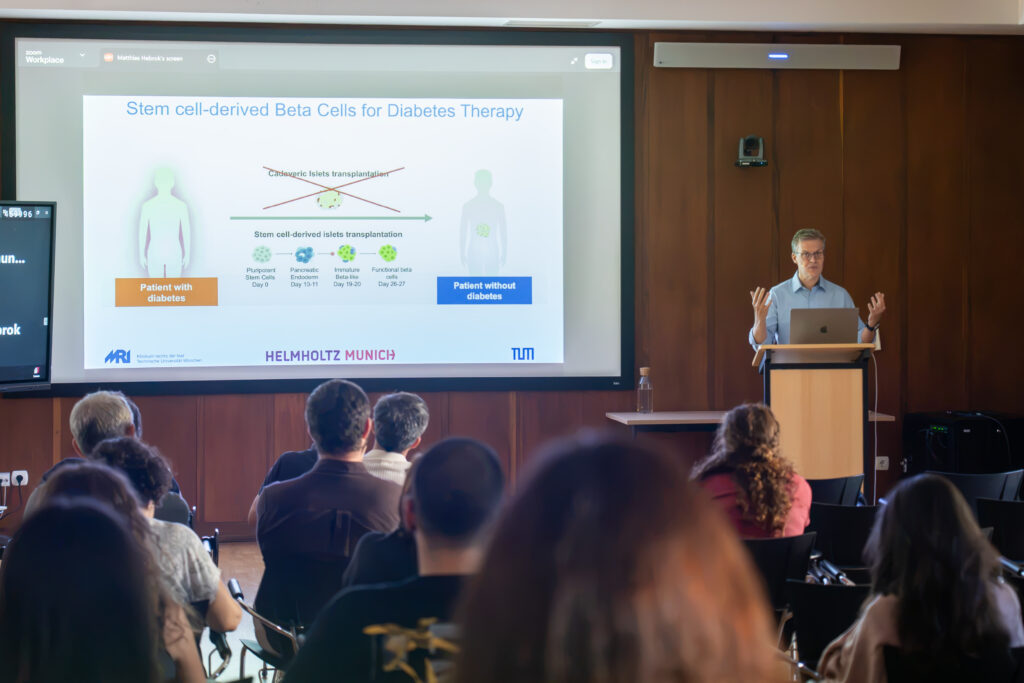
In his talk at GIMM, “Using human stem cells to optimize beta cells for therapy and model pancreatic cancer”, Matthias Hebrok, from the Technical University Munich, explored how stem cell technologies could help address two major diseases of the pancreas: diabetes and pancreatic cancer.
The pancreas is a complex organ, made up of several different cell types and, as explained during the seminar, Matthias’ work goes beyond simply generating pancreatic cells in the laboratory. The aim is to understand what makes these cells functional and resilient, and to develop models that can help reveal how disease evolves.
Endocrine cells are responsible for producing hormones such as insulin, which regulates blood glucose levels. When insulin-producing beta cells are lost or become dysfunctional, diabetes, a disease that affects 11% of the world population, can develop. Today, transplantation of pancreatic islets can restore glucose control in some patients, but the availability of donor tissue is extremely limited.
Stem cell technologies offer a potential way around this problem. By differentiating pluripotent stem cells into pancreatic cells, researchers can generate large numbers of insulin-producing beta cells for transplantation. Clinical studies have already shown the potential of this approach: stem-cell-derived islets have been transplanted into patients, with some maintaining normal blood glucose levels and becoming less dependent on insulin.
But, according to Hebrok, the current generation of stem-cell-derived islets is only the beginning. “What everyone is working on […] will be the next generation of stem cell islets.”
The challenge is to make these cells behave more like mature human beta cells. Hebrok presented research focusing on MafA, a transcription factor that directly activates insulin expression and whose levels and activity change as beta cells mature. His team’s experiments show that increasing MafA expression in stem-cell-derived beta cells can increase markers of beta-cell identity and improve their functionality. The cells also show increased metabolic activity and appear better equipped to cope with oxidative stress.
This points towards a broader ambition: creating cells that are not only functional, but capable of responding intelligently to the challenges they encounter after transplantation. Hebrok described his vision as generating “smart, self-healing cells” that can recognise specific stressors and activate protective responses when needed.
However, simply increasing cellular metabolism is not enough. Cells need energy to function, but excessive metabolic activity can also generate harmful reactive oxygen species and eventually lead to cellular exhaustion. This is why Hebrok’s team is exploring ways of making these responses conditional. For example, they have developed systems that activate specific genetic programmes only when a particular stress, such as hypoxia, is present, rather than maintaining them permanently.
On the second part of the talk, Hebrok focused on pancreatic cancer, a disease that remains particularly difficult to diagnose and treat. Unlike some other cancers, pancreatic cancer is often detected at a late stage, when treatment options are limited. Hebrok’s team is therefore using stem cell technology not only to study the disease, but to recreate aspects of the pancreas in the laboratory.
The researchers have developed pancreatic organoid models with increasingly complex structures, including branched, hollow duct-like architectures that more closely resemble the organisation of the human pancreas. They can then introduce genetic changes associated with pancreatic cancer and observe how the cells and their architecture change over time.
The ultimate goal is to understand what happens before a fully developed tumour emerges. By recreating early stages of disease, researchers hope to identify the molecular changes and biomarkers that could signal the development of pancreatic cancer much earlier than is currently possible.
“The idea would be to go into an earlier stage before it has become a full-grown cancer, identify the biomarkers, identify the molecules.”
In the longer term, this could open the door to preventive strategies rather than relying solely on treating established tumours. Hebrok even imagined a future in which cancer prevention could become part of routine healthcare. His final message was one of optimism about the potential of stem cell research. Referring to the early days of aviation, when the possibility of human flight was still dismissed by some, he drew a parallel with today’s scientific challenges. “We are about to take off and actually with the stem cells we’re already taking off. […] I think this is just the beginning.”