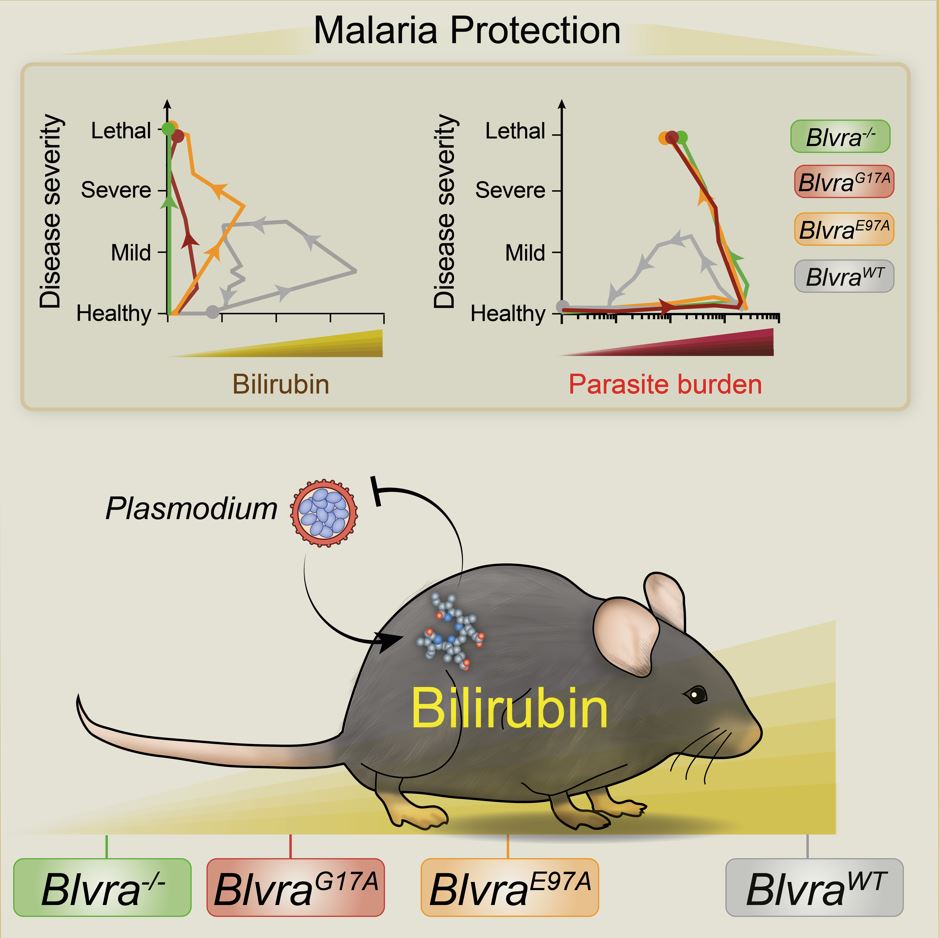
A study led by researchers from the Miguel Soares Lab, in collaboration with Bindu Paul from the Johns Hopkins University, has uncovered a crucial detail in the body’s natural defense against malaria: protection depends not only on the presence of bilirubin, as identified previously, but on reaching a minimum protective threshold during infection.
Published in iScience (Hypomorphic biliverdin reductase a mutations define bilirubin anti-malarial threshold: iScience), the paper builds on findings reported last year in Science, where the team first demonstrated that bilirubin (the yellow pigment traditionally associated with jaundice) can directly impair the survival of the malaria parasite Plasmodium spp.
The previous study revealed that bilirubin acts as a natural anti-malarial molecule, interfering with essential parasite detoxification pathways inside red blood cells. But an important question remained unanswered: was bilirubin itself responsible for the protective effect, or could other functions of the enzyme that produces it also play a role?
To address this, the researchers focused on biliverdin reductase A (BVRA), the enzyme responsible for converting biliverdin into bilirubin. Beyond its enzymatic role, BVRA has been shown to participate in several other cellular processes, including signaling and gene regulation.
Using cutting edge genetically engineering approaches available at GIMM, the team selectively disrupted the regions of BVRA required for bilirubin production while preserving the protein’s other biological functions. This allowed the team to isolate the specific contribution of bilirubin during malaria infection.
“What we wanted to understand was whether protection against malaria came specifically from bilirubin production or from one of the other functions attributed to BVRA,” explains Miguel Mesquita, PhD student at GIMM and first author of the study.
The experiments led to an unexpected discovery. One of the engineered mutations did not completely abolish bilirubin production, but instead created what researchers describe as a “hypomorphic” condition: the animals still produced bilirubin, though at lower levels than normal. “At first, we thought we had simply blocked bilirubin production,” says Mesquita. “But what we discovered was much more interesting: these animals could still produce bilirubin at baseline levels, yet they failed to increase production during infection compared to control animals.”
When infection reaches its peak, healthy animals dramatically increase circulating bilirubin levels. “These mutant animals could not cross that critical threshold and that small difference was enough to determine survival”, Mesquita stresses.
The study therefore identifies, for the first time, the existence of a minimal bilirubin threshold required for protection against severe malaria. These findings also reinforce the idea that bilirubin’s biological role depends on careful balance. Although toxic at excessive concentrations, the molecule appears to provide an important protective advantage during infection by directly targeting the parasite.
According to Miguel Soares, “bilirubin needs to attain a threshold level to interfere with the parasite’s ability to detoxify heme, the molecule responsible for carrying oxygen and giving blood its red colour”, a mechanism similar to the one targeted by chloroquine, one of the first antimalarial drugs.
“It’s precisely because bilirubin is toxic that it can harm the parasite,” Mesquita explains. “But, like many biological systems, everything depends on balance.” Beyond advancing the understanding of malaria resistance, the work opens new perspectives for therapies aimed at modulating bilirubin metabolism and strengthening the body’s own protective responses against infectious disease.