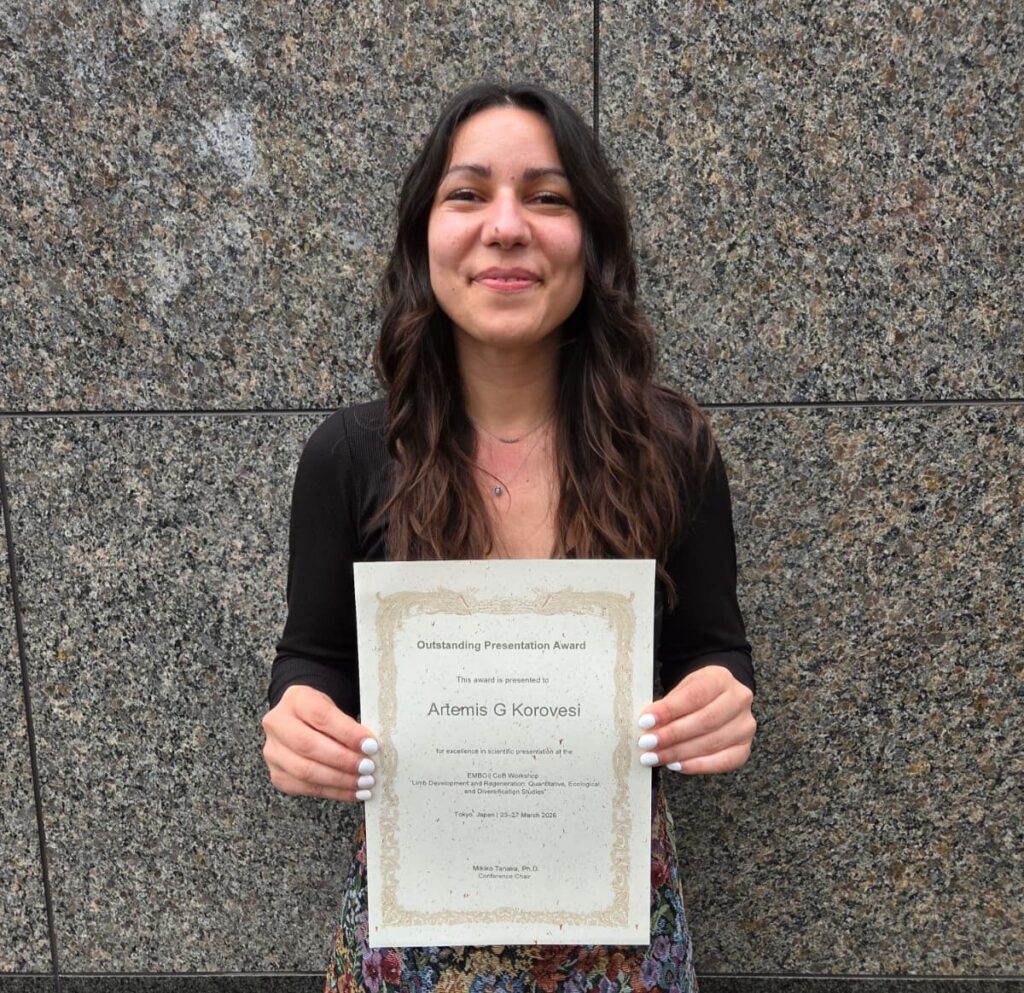
Artemis Korovesi, a final-year PhD student at the Moisés Mallo Lab, is approaching the final stretch of her doctoral journey but her work has already started being noticed internationally. Selected to present her findings in an oral presentation at a recent EMBO meeting in Tokyo – her first experience both at the conference and in Japan – she was awarded the Outstanding Presentation Award at the EMBO Workshop on Limb Development and Regeneration 2026. “Extremely honored to have received the Outstanding Presentation Award for my talk,” she said, reflecting on the experience. “It was an incredible opportunity to engage directly with the community and receive valuable feedback.”
Her research work is dedicated to a long-standing question in developmental biology: how can structures that begin through nearly identical developmental programs give rise to entirely different organs? Working with mouse embryos, Artemis focuses on the development of hindlimbs and external genitalia – two structures that emerge side by side and initially follow remarkably similar genetic programs. “Although hindlimbs and external genitalia arise in close proximity and rely on common signaling inputs during early bud formation, their developmental outcomes diverge significantly,” she explains.
At the core of her work is the discovery of a molecular signature linked to a shared progenitor tissue – cells capable of giving rise to either structure. This finding reveals an unexpected level of developmental plasticity, suggesting that early embryonic cells retain multiple potential fates before committing to a specific developmental path. Her research also sheds light on the regulatory mechanisms that drive this divergence, acting downstream of the key regulator TGF-beta receptor 1 signaling, and the complex interplay between enhancers and promoters that ultimately shape organ identity. The work is done on stages prior to sexual differentiation, when male and female embryos still follow a common developmental blueprint. By focusing on these early phases, her work uncovers fundamental mechanisms that are conserved across sexes, and potentially across species.
Blending experimental biology with computational analysis, she works across single-cell sequencing, bulk RNA sequencing and epigenomics, developing her own analytical pipelines along the way. Originally trained in biology, she embraced bioinformatics to deepen her understanding of gene regulation.
“I’ve long been fascinated by genes and how their regulation shapes biological processes,” she says. “My research interests focus on genomics and epigenomics, and I would like to continue exploring how gene regulatory networks evolve to generate morphological novelty and diversity.”
Now preparing her main PhD manuscript for submission, Artemis is also building international collaborations. As she approaches the end of her PhD, her next steps remain open – but her scientific path is clearly defined.