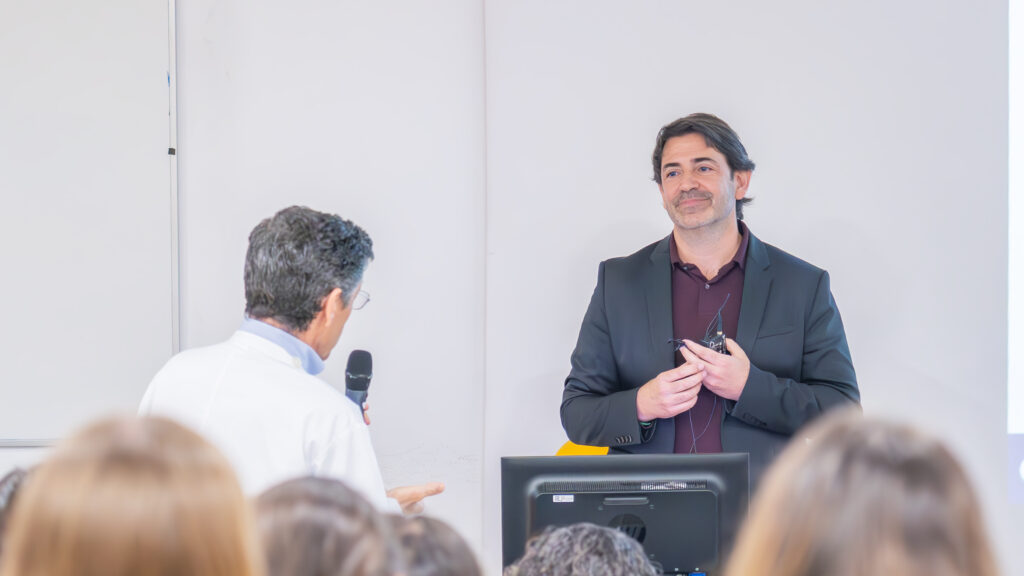
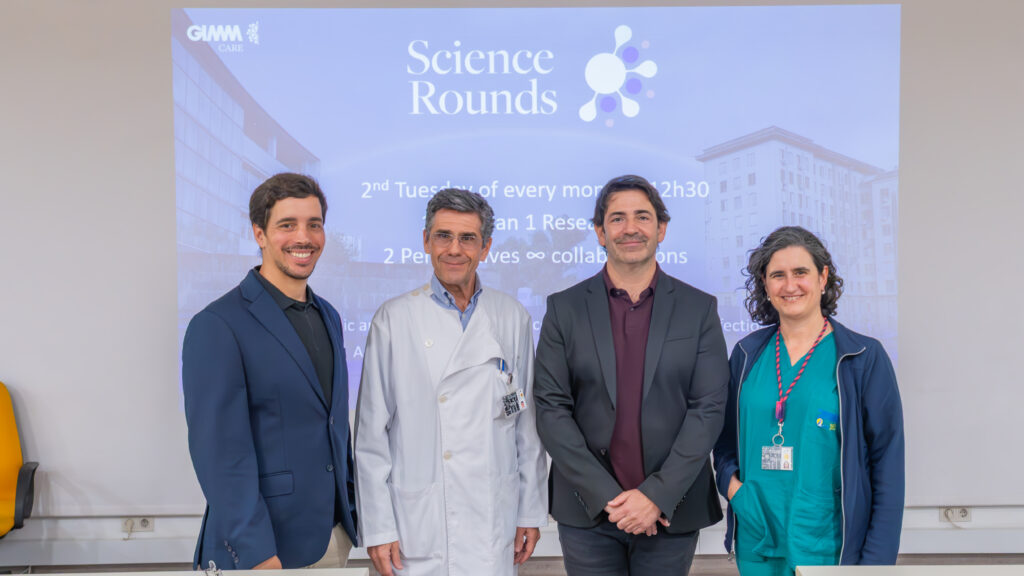
Life is a constant balance between costs and benefits, and nowhere is this more evident than in the immune system. This idea ran throughout Science Rounds, held on April 14, where two talks explored how the immune system can be both a life-saving ally and a source of serious complications, and how new therapies aim to restore that balance.
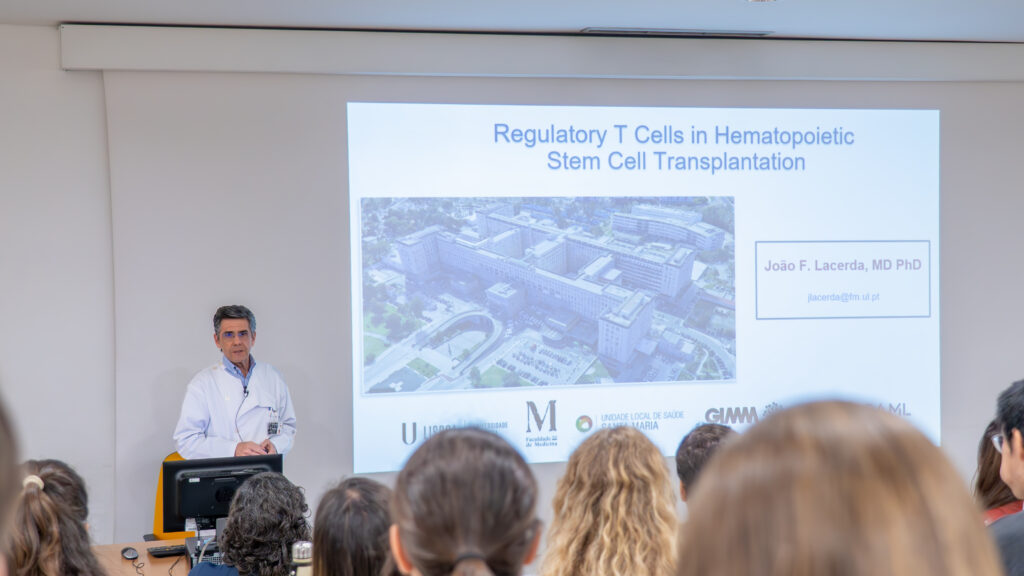
In “Regulatory T cells in Hematopoietic Stem Cell Transplantation,” João Lacerda, hematologist at ULS Santa Maria and GIMM Group Leader, focused on chronic graft-versus-host disease (cGVHD), one of the most challenging complications following bone marrow transplantation. Affecting up to 50% of patients, cGVHD arises when donor immune cells attack the patient’s own tissues, a paradox in a treatment designed to cure.
“There has to be an equilibrium,” Lacerda explained, referring to the delicate balance between beneficial immune responses that prevent cancer relapse and harmful reactions that drive chronic disease.
At the center of this imbalance are regulatory T cells (Tregs), rare immune cells responsible for keeping immune responses in check. Lacerda’s team showed that patients who develop cGVHD forbearance exhibit early defects in this compartment, long before clinical symptoms emerge. “We start seeing these changes prior to the development of clinical chronic GVHD,” he noted, pointing to reduced Treg numbers, impaired proliferation, and a disrupted balance with conventional T cells.
These insights led to a therapeutic strategy: restoring immune balance by reinfusing Tregs. In phase I clinical trials conducted in Portugal and Spain, patients with severe, treatment-resistant cGVHD received regulatory T cells collected from their original donors, even years after transplantation.
The results were promising. “It appears to be safe,” Lacerda reported, with no major toxicity observed. Clinically, most patients showed improvement: “Twelve of nineteen patients in Portugal and ten of twelve in Seville responded,” he said. Importantly, these responses allowed for a reduction in immunosuppressive therapies. “We were able to decrease steroid doses and, in many cases, discontinue other treatments altogether.”
Beyond clinical outcomes, the team demonstrated that the infused cells could persist in patients for up to a year. “We were able to detect the infused clonotypes up to one year post-infusion,” Lacerda added. Looking ahead, the research is moving toward more targeted approaches, including the development of antigen-specific Tregs with enhanced suppressive capacity.
If Lacerda’s talk focused on restraining an overactive immune response, Bruno Silva-Santos, in “Developing a novel adopted cell immunotherapy for acute myeloid leukemia,” addressed the opposite challenge: how to strengthen it against one of the deadliest blood cancers.
Chemotherapy remains the frontline treatment for acute myeloid leukemia (AML), but its limits are clear. “Although it’s very efficacious initially, a lot of patients, around 75%, will relapse,” said Bruno Silva-Santos, pointing to the urgent need for alternatives in what he described as “the most aggressive of all blood cancers.”
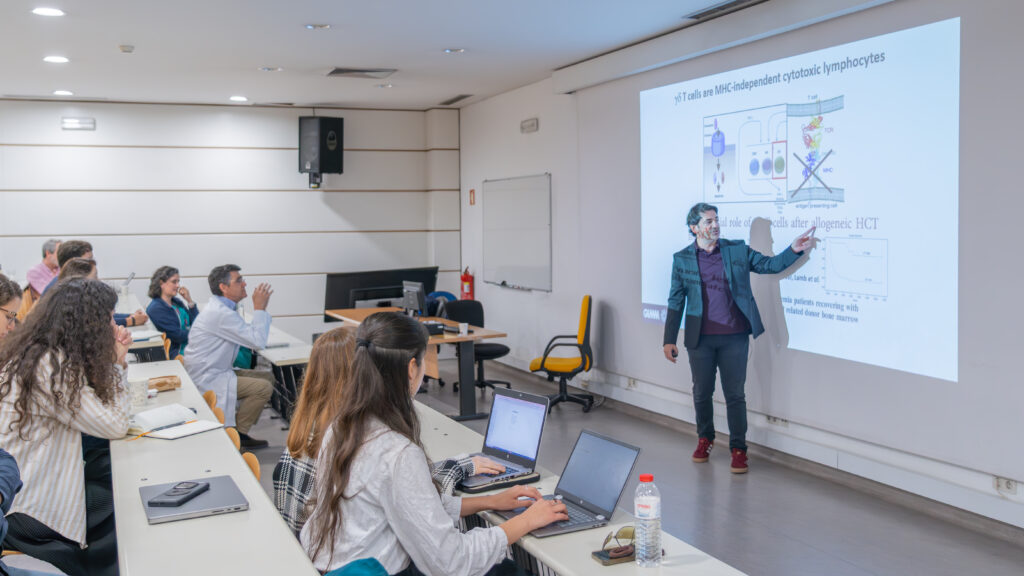
In his talk, Silva-Santos presented a new immunotherapy strategy centered on a less conventional player in the immune system: gamma delta (γδ) T cells. Unlike the better-known alpha-beta T cells, these cells do not rely on MHC recognition – an advantage that allows them to be used across donors/ recipients without triggering graft-versus-host disease. “They basically could not care less about the MHC expressed by the host cells,” he noted, highlighting their potential for safer, off-the-shelf therapies.
Within this population, his team focused on a rare subset, DeltaOne T cells, which, despite representing just 0.3% of circulating immune cells, showed superior ability to kill leukemia cells. “Delta-1 won,” he said, recalling the early experiments that led his lab to shift focus against prevailing trends in the field.
The challenge, however, was scale up. To turn these rare cells into a viable therapy, the team developed a complex expansion protocol capable of increasing their numbers more than 2,000-fold. “We were now finally getting to the numbers needed for a cell therapy,” he explained.
The resulting cell product, enriched in DeltaOne T cells, showed excellent results in preclinical models. In patient-derived AML samples, up to 80% of cancer cells were eliminated within hours, with complete clearance observed overnight. Crucially, the effect appeared highly selective. “There is no killing of any healthy cell we’ve tried until now,” Silva-Santos said.
These findings led to a first-in-human clinical trial, which will guarantee safety, but highlight the need for more potency. That next step was the focus of the second half of his talk, about engineering these cells with a chimeric antigen receptor (CAR), a strategy already used in CAR-T therapies. In mouse models, the engineered CAR-γδ T cells not only controlled tumor growth more effectively but also prevented its spread. “They don’t have circulating tumor cells,” Silva-Santos noted, describing how treated animals showed no signs of dissemination to other organs. Even a single injection was enough to sustain long-term control in most cases – results that should be published soon.
Now, with industry partners involved and further development underway, Silva-Santos sees this approach as a promising path forward for patients with few options left. “We really hope,” he said, “to take this translational research to the benefit of AML patients.” Together, the two talks highlighted opposite ends of the same spectrum: when to restrain the immune system and when to unleash it. Both approaches, grounded in cellular immunotherapy, point toward a future where precise control of immune responses could transform patient outcomes.
Life is a constant balance between costs and benefits, and nowhere is this more evident than in the immune system. This idea ran throughout Science Rounds, held on April 14, where two talks explored how the immune system can be both a life-saving ally and a source of serious complications, and how new therapies aim to restore that balance.
In “Regulatory T cells in Hematopoietic Stem Cell Transplantation,” João Lacerda, hematologist at ULS Santa Maria and GIMM Group Leader, focused on chronic graft-versus-host disease (cGVHD), one of the most challenging complications following bone marrow transplantation. Affecting up to 50% of patients, cGVHD arises when donor immune cells attack the patient’s own tissues, a paradox in a treatment designed to cure.
“There has to be an equilibrium,” Lacerda explained, referring to the delicate balance between beneficial immune responses that prevent cancer relapse and harmful reactions that drive chronic disease.
At the center of this imbalance are regulatory T cells (Tregs), rare immune cells responsible for keeping immune responses in check. Lacerda’s team showed that patients who develop cGVHD forbearance exhibit early defects in this compartment, long before clinical symptoms emerge. “We start seeing these changes prior to the development of clinical chronic GVHD,” he noted, pointing to reduced Treg numbers, impaired proliferation, and a disrupted balance with conventional T cells.
These insights led to a therapeutic strategy: restoring immune balance by reinfusing Tregs. In phase I clinical trials conducted in Portugal and Spain, patients with severe, treatment-resistant cGVHD received regulatory T cells collected from their original donors, even years after transplantation.
The results were promising. “It appears to be safe,” Lacerda reported, with no major toxicity observed. Clinically, most patients showed improvement: “Twelve of nineteen patients in Portugal and ten of twelve in Seville responded,” he said. Importantly, these responses allowed for a reduction in immunosuppressive therapies. “We were able to decrease steroid doses and, in many cases, discontinue other treatments altogether.”
Beyond clinical outcomes, the team demonstrated that the infused cells could persist in patients for up to a year. “We were able to detect the infused clonotypes up to one year post-infusion,” Lacerda added. Looking ahead, the research is moving toward more targeted approaches, including the development of antigen-specific Tregs with enhanced suppressive capacity.
If Lacerda’s talk focused on restraining an overactive immune response, Bruno Silva-Santos, in “Developing a novel adopted cell immunotherapy for acute myeloid leukemia,” addressed the opposite challenge: how to strengthen it against one of the deadliest blood cancers.
Chemotherapy remains the frontline treatment for acute myeloid leukemia (AML), but its limits are clear. “Although it’s very efficacious initially, a lot of patients, around 75%, will relapse,” said Bruno Silva-Santos, pointing to the urgent need for alternatives in what he described as “the most aggressive of all blood cancers.”
In his talk, Silva-Santos presented a new immunotherapy strategy centered on a less conventional player in the immune system: gamma delta (γδ) T cells. Unlike the better-known alpha-beta T cells, these cells do not rely on MHC recognition – an advantage that allows them to be used across donors/ recipients without triggering graft-versus-host disease. “They basically could not care less about the MHC expressed by the host cells,” he noted, highlighting their potential for safer, off-the-shelf therapies.
Within this population, his team focused on a rare subset, DeltaOne T cells, which, despite representing just 0.3% of circulating immune cells, showed superior ability to kill leukemia cells. “Delta-1 won,” he said, recalling the early experiments that led his lab to shift focus against prevailing trends in the field.
The challenge, however, was scale up. To turn these rare cells into a viable therapy, the team developed a complex expansion protocol capable of increasing their numbers more than 2,000-fold. “We were now finally getting to the numbers needed for a cell therapy,” he explained.
The resulting cell product, enriched in DeltaOne T cells, showed excellent results in preclinical models. In patient-derived AML samples, up to 80% of cancer cells were eliminated within hours, with complete clearance observed overnight. Crucially, the effect appeared highly selective. “There is no killing of any healthy cell we’ve tried until now,” Silva-Santos said.
These findings led to a first-in-human clinical trial, which will guarantee safety, but highlight the need for more potency. That next step was the focus of the second half of his talk, about engineering these cells with a chimeric antigen receptor (CAR), a strategy already used in CAR-T therapies. In mouse models, the engineered CAR-γδ T cells not only controlled tumor growth more effectively but also prevented its spread. “They don’t have circulating tumor cells,” Silva-Santos noted, describing how treated animals showed no signs of dissemination to other organs. Even a single injection was enough to sustain long-term control in most cases – results that should be published soon.
Now, with industry partners involved and further development underway, Silva-Santos sees this approach as a promising path forward for patients with few options left. “We really hope,” he said, “to take this translational research to the benefit of AML patients.” Together, the two talks highlighted opposite ends of the same spectrum: when to restrain the immune system and when to unleash it. Both approaches, grounded in cellular immunotherapy, point toward a future where precise control of immune responses could transform patient outcomes.