 Support initiatives that lead to scientific breakthroughs with the potential to transform lives
worldwide.
Support Us
Support initiatives that lead to scientific breakthroughs with the potential to transform lives
worldwide.
Support Us
Paula Duque Lab
Plant Molecular Biology
Paula Duque Lab
Plant Molecular Biology
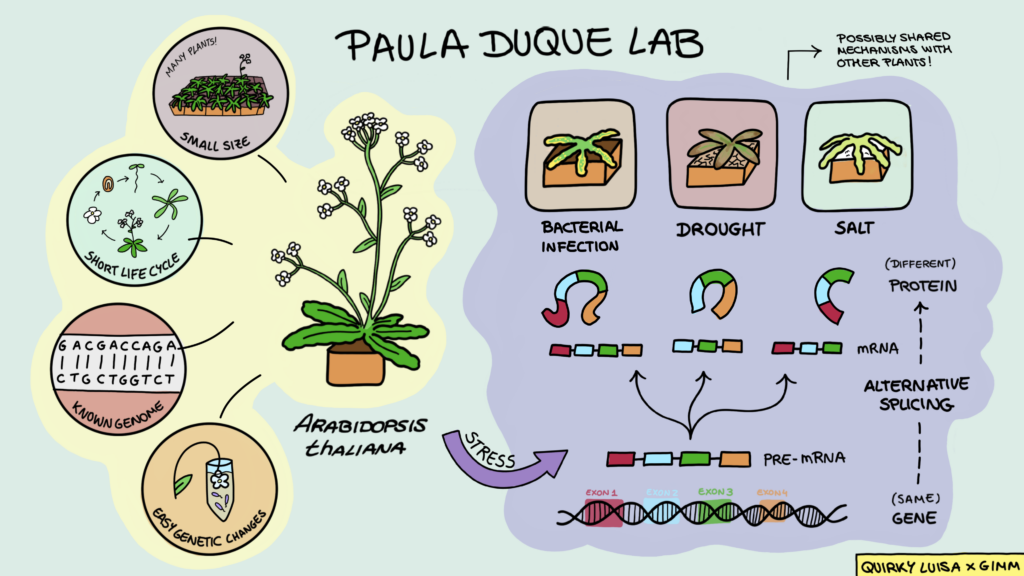
Our research group uses the model system Arabidopsis thaliana, combining genetics, molecular and cell biology, and computational methods to investigate how plants perceive and respond to external and endogenous signals at the molecular level. We focus primarily on the roles of alternative splicing and membrane transport, uncovering novel molecular players involved in plant development and stress tolerance. Our fundamental research on the conserved molecular mechanisms that plants employ to ensure growth under environmental stress is essential not only for advancing fundamental biology but also for defining translational strategies to address the increasing challenges that climate change poses to agriculture.
Funders

Posttranscriptional regulation is crucial for accurate gene expression and largely governed by RNA-binding factors, such as the highly conserved serine/arginine-rich (SR) proteins, which are major regulators of alternative splicing. Our recent work highlights Arabidopsis SR proteins as central hubs of a posttranscriptional network that controls development and stress tolerance during early plant growth. To unravel this network, we are employing a multidisciplinary approach to elucidate the molecular functions of these splicing factors and decipher the RNA code determining the activation or repression of stress signaling during the first steps of development, which are crucial for establishing a viable plant.
Another line of work in the lab is uncovering a broad role for Major Facilitator Superfamily (MFS) transporters in plant stress tolerance and gaining mechanistic insight into their modes of action. Despite standing as the largest known group of secondary active membrane transporters and being ubiquitous to all living organisms, the MFS remains poorly studied. Using reverse genetics in Arabidopsis, heterologous expression and complementation experiments in yeast, as well as transport assays in both systems, we are. revealing crucial MFS roles in a plant’s fitness to cope with some of the most pervasive forms of environmental stress, such as drought, soil mineral deficiencies or heavy metal contamination. Interestingly, the functional analysis of these membrane proteins has revealed striking examples of the biological impact of alternative splicing in plants.
- A splicing factor regulating seed size and stress response during germination. Fundação para a Ciência e a Tecnologia (FCT) Grant PTDC/ASP-PLA/2550/2021
- Characterization of a putative gibberellin exporter in arabidopsis and rice. Fundação para a Ciência e a Tecnologia (FCT) Grant 03584.PTDC
- Translational regulation of a plant heavy metal transporter by upstream Open Reading Frames (uORFs).Fundação para a Ciência e a Tecnologia (FCT) Grant PTDC/ASP-PLA/6105/2020
- Díez AR, Szakonyi D, Lozano-Juste J, Duque P (2024) Alternative splicing as a driver of natural variation in ABA response. The Plant Journal 119: 9-27.
- Laloum T, Carvalho SD, Martín G, Richardson DN, Cruz TMD, Carvalho RF, Stecca KL, Kinney AJ, Zeidler M, Barbosa ICR, Duque P (2023) The SCL30a SR protein regulates ABA-dependent seed traits and germination under stress. Plant Cell & Environment 46(7): 2112-2127.
- Albuquerque-Martins R, Szakonyi D, Rowe J, Jones AM, Duque P (2023) ABA signaling prevents phosphodegradation of the SR45 splicing factor to alleviate inhibition of early seedling development in Arabidopsis. Plant Communications 4(2): 100495.
- Martín G, Duque P (2021) Tailoring Photomorphogenic Markers to Organ Growth Dynamics. Plant Physiology186(1): 239-249.
- Martín G, Márquez Y, Mantica F, Duque P, Irimia M (2021) Alternative splicing landscapes in Arabidopsis thaliana across tissues and stress conditions highlight major functional differences with animals. Genome Biology 22(1): 35.
- Niño-González M, Novo-Uzal E, Richardson DN, Barros PM, Duque P (2019) More transporters, more substrates: The arabidopsis Major Facilitator Superfamily revisited. Molecular Plant 12(9): 1182-1202.
- Laloum T, Martín G, Duque P (2018) Alternative splicing control of abiotic stress responses. Trends in Plant Science 23(2): 140-150.
- Remy E, Niño-González M, Godinho CP, Cabrito TR, Teixeira MC, Sá-Correia I, Duque P (2017) Heterologous expression of the yeast Tpo1p or Pdr5p membrane transporters in Arabidopsis confers plant xenobiotic tolerance. Scientific Reports 7: 4529.
- Carvalho RF, Szakonyi D, Simpson CG, Barbosa ICR, Brown JWS, Baena-González E, Duque P (2016) The Arabidopsis SR45 splicing factor, a negative regulator of sugar signaling, modulates SNF1-related protein kinase 1 (SnRK1) stability. The Plant Cell 28(8): 1910-25.
- Remy E, Cabrito TR, Batista RA, Hussein MAM, Teixeira MC, Athanasiadis A, Sá-Correia I, Duque P (2014) Intron retention in the 5’UTR of the novel ZIF2 transporter enhances translation to promote zinc tolerance in Arabidopsis. PLoS Genetics 10(5): e1004375.
- Member of the Scientific Advisory Board, Institute of Plant Biochemistry and Photosynthesis (IBVF), University of Seville – CSIC, Spain (since 2024)
- Associate Editor for Plant Cell Biology, Frontiers in Plant Science (since 2020)
- Member of EMBO, European Molecular Biology Organization (since 2017)
- Member of the Editorial Board, Scientific Reports, Nature Publishing Group (since 2015)
- Member of the Executive Board, International PhD Program Plants for Life, ITQB-NOVA, Portugal (since 2014)
- Scientific Advisory Board, Plant-KBBE transnational funding initiative, FCT, Portugal (2013-2015)
- Council Member of the SPBP, Portuguese Society of Plant Biology (2013-2024)
Team




Related News
Releasing the brakes on the brake: How plants learn to grow under extreme conditions
June 18.2026 Discovery
In a laboratory where plants grow under carefully controlled light, research can begin with an apparently simple question: How does a seed survive when the […]
Read more ⇾
How a Stress Hormone Prevents Plants from Opening Their First Leaves
June 20.2025 Discovery
A new study, published today in the journal EMBO Reports* and conducted in the laboratory led by Paula Duque, researcher at the Gulbenkian Institute for […]
Read more ⇾
Alternative splicing for a world with more resilient crops
January 30.2025 GIMM
Much like animals, plants are susceptible to a broad range of pathogens. Every year, up to 40% of global crop production is lost to infections […]
Read more ⇾